




A meeting between the AFL and 18 club presidents — billed as a potential showdown over the future of Tasmania — has failed to deliver any fireworks, as the league doubles down on its commitment to welcoming the Devils into the AFL men’s competition in 2028.
Media reports had suggested that the AFL would be confronted over concerns that a cost rise to the planned Macquarie Point Stadium would place the 19th license in jeopardy, and that the consequences of a budget blowout may be borne by the league and its stakeholder clubs.
But it’s understood the topic of Tasmania was not even an official agenda item at the annual meeting, which was held in Melbourne prior to the Australian Football Hall of Fame function on Tuesday night.
A handful of questions about Tasmania, the planned Macquarie Point Stadium and Kingston Training and Administration base were only raised towards the end of the meeting by Port Adelaide president David Koch, with one question about a hypothetical stadium budget blowout.
AFL CEO Andrew Dillon (left) said he expected the Tasmania Devils men would debut for the 2028 season. (ABC News: Luke Bowden)
It led to a renewed assurance from AFL chief executive Andrew Dillon that Tasmania would enter the men’s competition in 2028, would be playing at Macquarie Point in 2031 and that work was progressing on the club’s $115 million training and admin facility.
Tasmania was represented at the meeting by chief executive Brendon Gale and board member Alicia Leis.
Mr Dillon told the ABC there was a brief conversation about Tasmania and the stadium at today’s meeting.
He said he was “absolutely” confident the team would play in the new stadium in 2031.
“There was a couple of questions on the timelines, but they’ll be met,”
he said.
“We’re really excited about the work that’s happened already, and we can’t wait for them to start in 2028”
“There were a lot of topics covered. We spoke about Tasmania, and the great work that Brendon Gale and the team are doing down there, particularly about the success of the VFL team down there”
New report forecasts increased costs
The meeting came on the same day a new economic report found the Macquarie Point Stadium would cost at least $1.5 billion, with one pessimistic scenario costing the build at $2.5 billion.
The report, compiled by economist Dr Nicholas Gruen, was commissioned by Hobart-based anti-stadium group ‘No New Stadium’, at a cost of $25,000.
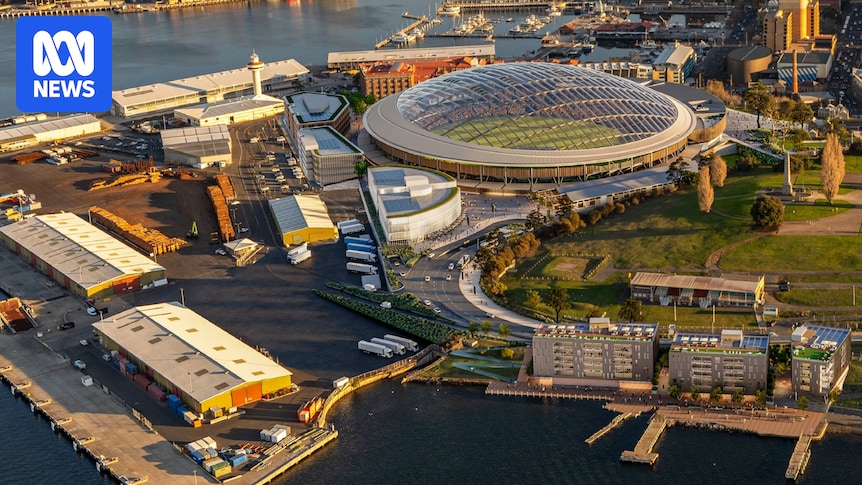
An artist’s impression of Macquarie Point stadium entry gate four in Hobart. (Supplied: Mac Point Site Master Plan Report)
Loading…
The report was not raised at the meeting by any of the 18 club presidents, the ABC understands.
Under the report’s new modelling, the stadium would add $2.3 billion to the state’s debt by the end of the 2030s, including the compounding interest bill.
Over the first 10 years, the state would pay $459 million in additional interest on the stadium-related debt, it says, potentially putting further pressure on the state’s credit rating.
The report estimates the stadium would deliver a cost-to-benefit ratio of 0.398.
“The stadium now returns less than 40 cents for every dollar of public money spent on it,” the report states.
“No plausible revision to the benefits can fully offset the expected capital cost growth.“
An artist’s impression of the Macquarie Point stadium entry gate 1 and retail precinct. (Supplied: Mac Point Site Master Plan Report)
On a per capita basis, the report calculates the net cost for each Tasmanian to be $1,831 under a “central” scenario.
No New Stadium spokesperson, Roland Browne, said Dr Gruen’s findings were “damning”.
“If this stadium was unaffordable in early 2025 when Dr Gruen did his first report, it’s woefully worse now,” Mr Browne said.
Tasmania Devils board member Alicia Leis was one of those representing Tasmania at the meeting. (ABC News: Damian McIntyre)
The numbers are at odds with the Macquarie Point Development Corporation’s official P90 cost estimate, compiled by quantity surveyors WT Partnership, late last year.
It found the stadium would cost $1.13 billion, including $147 million of contingency.
A P90 estimate is a construction estimate by an independent quantity surveyor that concludes the cost only has a 10 per cent chance of exceeding the estimate.
Options available if more funds needed, minister says
Works are set to commence at Macquarie Point next month, with Hazell Brothers and Hunter Mason awarded contracts to pack down the Goods Shed, which currently occupies part of the site, and to commence initial earthworks.
Two multinational contractors are bidding for the right to build the stadium, including BESIX Watpac, which is also building Brisbane’s new Olympic stadium.
There are also questions about how any funding shortfall would be covered, should quotes from those competing tenderers be submitted that are higher than the allocated budget.
State stadium funding has been capped at $875 million, with $240 million to come from the federal government and $15 million from the AFL, to make up the $1.13 billion.
Any money above and beyond that would need to be sought, most likely from non-state government sources.
‘Levers’ available if funding falls short, govt says
Minister for Sport Nick Duigan said on Tuesday there were “levers” that could be pulled should the government require more funds.
He wouldn’t be drawn on any potential cost blowout, citing the tender process in which the stadium project is currently subject to.
“There’ll be a number of levers that are available in that eventuality,”
he said.
“But at this point, we need to be in this competitive process to get the consortium on board who’ll do the best job for our state in delivering that really important piece of infrastructure.”
What those levers are, and how many more funds might be required, remains unclear.
Mr Duigan said he had not read the new report by Dr Gruen and could not comment directly on its findings.
Loading…