





BENGALURU: When Japanese student Hirotoshi Tanaka came to Bengaluru in 2019, he had one simple plan — to learn English, experience life in India and eventually return to his parents in Tokyo.Instead, his journey took him from a police station to Bengaluru Central Prison, then to the Karnataka high court, the Karnataka State Human Rights Commission and eventually a detention centre before he was deported to Japan in April 2021.Nearly seven years after arriving in the city, Tanaka has now received Rs 75,000 in compensation from the Karnataka government after the human rights commission held that he had been unnecessarily kept in judicial custody for 19 days.But perhaps the most unusual chapter of his long legal battle came in the early hours of February 28, 2021, when Tanaka walked into the office of the JC Nagar assistant commissioner of police in RT Nagar, picked up a white plastic chair, took selfies with it and carried it back to his home in BTM Layout.He was not trying to steal the chair. He wanted the police to arrest him.Tanaka believed that an arrest would give him a way to remain in India while pursuing his human rights complaint. By then, he was struggling financially, his immigration status was uncertain and he had been ordered to leave the country.The chair, in his telling, was not about theft. It was a desperate attempt to force the police to notice him.But to understand how a Japanese student came to steal a police officer’s chair just to get arrested, the story goes back to 2019.A journey to BengaluruA 36-year-old psychology graduate at the time, Tanaka arrived in Bengaluru in 2019 and enrolled at a private English academy.Tanaka was dissatisfied with the academy after classes were allegedly cancelled frequently and conducted irregularly. He said repeated attempts to seek an explanation from the academy’s head went unanswered, leading to growing tensions.The dispute eventually escalated into an argument. He alleged that he was then provoked, lost his temper and punched the academy head.
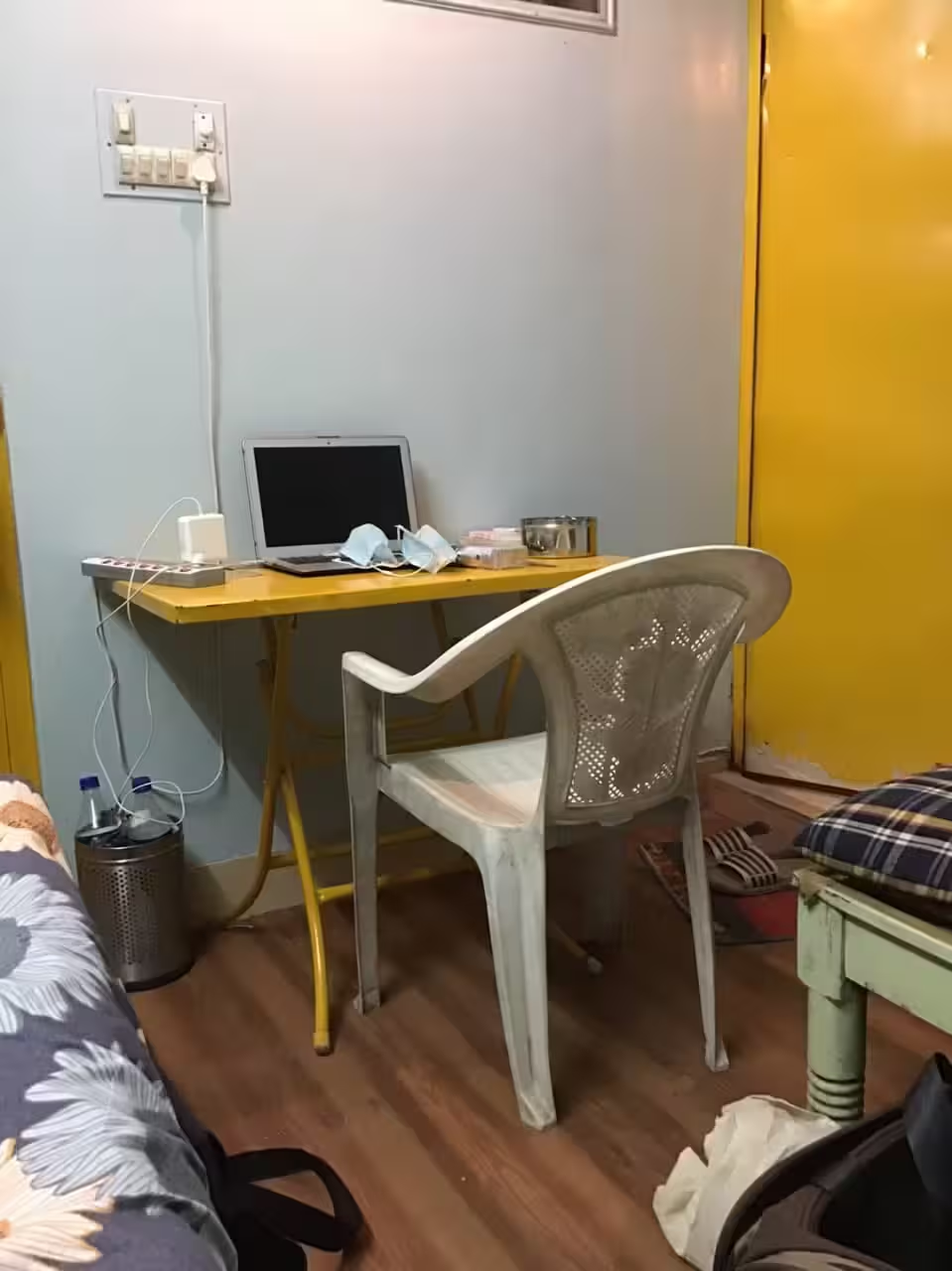
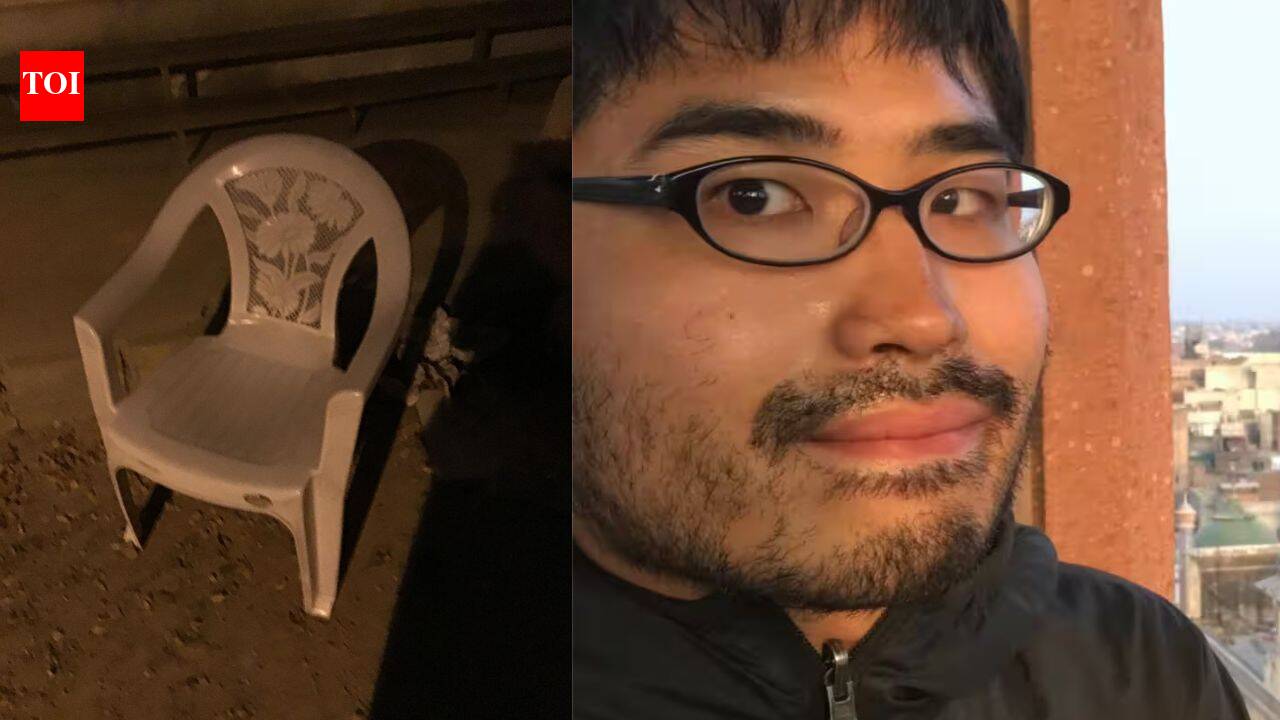
The ‘stolen’ chair (Image Credit: Special arrangement)
Following the altercation, the RT Nagar police registered a case against him under charges of voluntarily causing hurt and criminal intimidation. Although the offences were bailable, Tanaka was arrested on November 23, 2019, and sent to Bengaluru Central Prison.He spent 19 days behind bars before being released on December 11.For a young Japanese student who had come to India to learn English, prison was a world away from what he had imagined.Looking back, Tanaka said the hardest part was not knowing what was happening to him or how he could get out.“I didn’t know anything about my case. Nothing was explained in the police station or before the magistrate,” he told TOI from Japan.“I didn’t know my section numbers. I didn’t even know legal terms like ‘advocate’, ‘bail’, ‘magistrate’, ‘custody’, ‘(criminal) case’ and so on. Initially I thought advocates meant friends or relatives so I was planning to ask cops of RT Nagar police station to be my advocate.”Not understanding the legal system or knowing how to secure his release made his time in prison particularly difficult.“That was a so surreal, kafkaesque experience. But thanks to criminals, jail police and jailers, I learned slowly about it in prison only. They were so supportive,” he said.An unlikely friend in jailTanaka recalled that there was a section for foreign prisoners known as the “Negro Room”, where English-language films were shown.“I went to Negro Room just to watch films and get tomato curry they cooked. They were allowed to cook for themselves. Jail Sambar was tasted terrible. They purposely use less salt and spices for health of inmates. Vegetables used for curry was fresh though,” he said.He said he was intimidated by some of the inmates and therefore spent time in the psychiatric ward inside the prison hospital.Yet, amid the difficulties, Tanaka also encountered people who helped him.“The Chief Superintendent allowed me to visit his office and gave me access to a computr,” he recalled.Then there was Shankar, who became his “closest friend”.“Shankar had been convicted of murdering three people but had become a deeply devoted Christian,” Tanaka said.“He accompanied me to the prison’s video-conference court hearings and stood by me when I had no money for bail. Without Shankar’s help, I don’t think I would have been able to leave prison.”Shankar was from Hubli and was shifted to Vijayapura jail in January 2020. Tanaka later gifted him items including a bag and keys.“I wish to meet him again. Shankar is very important person in my life,” Tanaka said.His health made his 19 days in prison even more difficult.Tanaka was taking medicines for ADHD (Attention-Deficit Hyperactivity Disorder) and insomnia before his arrest. But his medical certificate was not in English, and the prison doctor did not give him his medicines.“I was so sick for 19 days without my medicine. My medical certificate was in my suitcase in a hostel in Koramangala,” he said.Tanaka said all his medicines were sedative ones, meaning the prison doctor could not prescribe them easily without the required medical documentation.Without his ADHD medication, he said, sounds became distorted, making it extremely difficult for him to understand spoken English.“My English wasn’t very good to begin with, so it made things even harder. Even the sound coming from the prison speakers seemed deafeningly loud to me,” he said.
An alleged bribery demand
Tanaka’s troubles did not end with his release.When he returned to the police station the following day to collect his belongings, he had very little money. He recalled that a constable, Raghavendra, noticed his financial condition and lent him Rs 1,500.However, Tanaka alleged that another officer, then sub-inspector B Hanumantharayappa, demanded a bribe from him.According to Tanaka, after negotiations he paid Rs 5,500, which also covered the amount he had borrowed. Days later, when he appeared before the court, he alleged that the officer again demanded Rs 3,000 to settle the case.Tanaka decided he would not simply pay and walk away.His father is a police officer in Japan, and Tanaka said he had great respect for the police. But he did not want to accept what he described as misconduct.“But not at the cost of my self-respect. I wanted to fight,” he said.The legal battle, however, was not the only challenge he faced.With little money and nowhere to stay, Tanaka claimed he spent nights in R.T. Nagar Park before being robbed of his belongings. Fearing for his safety, he began sleeping inside the premises of the R.T. Nagar Police Station.One night, he lost consciousness and later woke up in the intensive care unit of Bowring Hospital.After being discharged in March 2020, a friend helped him find accommodation in BTM Layout.Then the Covid-19 pandemic brought another layer of uncertainty to his already complicated situation.
A fight continues
Tanaka eventually approached the Karnataka high court, challenging the criminal proceedings against him.After the coaching centre’s head agreed to settle the dispute, the HC, on November 2, 2020, quashed the FIR and all criminal proceedings against him.The criminal case that had resulted in his arrest and 19 days in prison was finally over.But Tanaka did not return to Japan.Instead, he decided to continue fighting what he believed was a larger injustice.In December 2020, Tanaka approached the Karnataka State Human Rights Commission, filing a complaint against an police offical, who has since retired.Tanaka told TOI that the idea to approach the commission came from an unexpected encounter at a hostel. He said the brother of a DCP advised him to take his case to the Human Rights Commission after the two met by chance and discussed his situation.According to Tanaka, the suggestion eventually led him to file his complaint against then RT Nagar police sub-inspector, who has since retired.Tanaka alleged that the officer had demanded a bribe from him to drop the case. He wanted action against the officer and also wanted the police department to bear his travel expenses.Tanaka alleged that the officer had demanded a bribe from him to drop the case. He sought action against the officer and wanted the police department to bear his travel expenses.But while he pursued the human rights complaint, his immigration status was becoming increasingly difficult.His visa had expired while the criminal case remained pending. He said officials from the Consulate-General of Japan in Bengaluru had approached the police on his behalf but were told that the matter was before the court.After the criminal case was quashed, the Foreigners Regional Registration Office directed Tanaka to leave India before February 28, 2021.Tanaka did not want to leave.He wanted to stay in India until his complaint before the human rights commission was addressed. At the same time, he said he was struggling financially and needed medicines.Tanaka told TOI that his immigration problems continued even after the criminal case was quashed.“My new visa was granted in July 2020 which was valid till Sep 2020. And it was extended till March 2021 as my criminal case was still pending. My case was quashed by the Karnataka high court November 2, 2020 so exit permit was issued and it worked as my visa. It was valid till the end of Dec 2020 but I didn’t return to Japan as I filed a complaint against the police before the Karnataka State Human Rights Commission.”Tanaka said that after he stayed back in India to pursue the complaint, the Foreigners Regional Registration Office filed a complaint against him at Mico Layout police station near his hostel in BTM Layout.“After some negotiations, Exit permit was extended till Feb 2021. The first hearing was scheduled in Febuary but the police didn’t not send the report on my case so it was postponed. I applied for extension of my exit permit but it had been under process for a couple of weeks.”Tanaka said he wanted to remain in India to attend the hearing but was also struggling financially.As the February 28 deadline approached, Tanaka came up with an unusual plan.He believed that if he committed a minor offence and was arrested, he could remain in India while pursuing his complaint.“I wish to attend the hearing and I though I I had to but I was penniless and application for new exit permit had been pending. So to clear my financing problems and visa problem I committed “theft”. But nothing happened,” he said.And that was when the plastic chair entered the story.
The chair ‘theft’
Around 1am on February 28, Tanaka entered the JC Nagar ACP’s office at RT Nagar. He picked up a white plastic chair from the reception area.Then he photographed himself with it. He carried the chair back to his home in BTM Layout and waited.There was no attempt to hide what he had done. Tanaka wanted the police to know.More importantly, he wanted them to arrest him. His reasoning was simple: an arrest, he believed, would allow him to remain in India while continuing his legal battle.It was an extraordinary move, but by then Tanaka’s options appeared limited. He had already spent 19 days in prison, had fought to get the criminal case quashed and was now facing an order to leave the country while his human rights complaint remained unresolved.The chair was never really about the chair.It was his desperate attempt to force the authorities to notice him.The human rights commission rules in his favourAfter eventually returning to Japan, Tanaka continued pursuing the case through his Bengaluru-based advocate Rohan Kothari.Following an inquiry, the Karnataka State Human Rights Commission ruled in his favour on May 9, 2022.The commission concluded that police officials had failed to justify his arrest in a case involving bailable offences, resulting in his unnecessary judicial custody for 19 days.The commission recommended that the Karnataka government pay Tanaka Rs 75,000 as compensation.It also recommended disciplinary proceedings against the police offical, recovery of the compensation amount from the officer and guidelines for police dealing with foreign nationals and illiterate persons during arrests.But the recommendations were not immediately implemented.Tanaka alleged that after waiting for months, he was still not paid the compensation.In September 2022, he approached the Karnataka High Court seeking enforcement of the commission’s order.The legal battle continued for years.This year, the State government informed the high court that it would comply with the KSHRC’s recommendations. In April, the State filed an affidavit stating that Rs 75,000 would be transferred to Tanaka through his counsel and that disciplinary proceedings had been initiated against Hanumantharayappa.The compensation was finally paid to Kothari on June 22.Tanaka’s advocate then transferred the amount to his Indian wife’s account on June 23.“My bank in Japan didn’t handle Indian Rupee so I asked Rohan to get the compensation. I think I can say I got 75k from Karnataka,” Tanaka said.
Seven years later
For Tanaka, the Rs 75,000 is the culmination of a legal battle that began with a dispute at an English academy and took him through a prison cell, courtrooms, an immigration fight and a human rights complaint.But his memories of Bengaluru are not entirely defined by the ordeal.He remembers the prison officials who helped him navigate a legal system he knew nothing about. He remembers the “Negro Room”, the tomato curry and the computer he was allowed to use in the Chief Superintendent’s office.And he remembers Shankar, the prisoner convicted of murdering three people who became his closest friend during the darkest period of his stay in India.Tanaka still wishes to meet him again.Speaking to TOI, Tanaka said he now wants to return to India, particularly to visit his wife’s hometown in the Northeast and meet her family.Asked whether he hopes to return to India someday, Tanaka said:“Yes. My wife is from North East and I wish to visit her hometown and meet her relatives as soon as possible. But I am still blackmailed thanks to deportation in 2021 so cannot reenter India. Now an advocate bases in Mumbai(not Rohan Kothari in Bangalore) is trying to have my name removed from blacklist”For the Japanese student who came to Bengaluru to learn English, the city ultimately gave him an experience he could never have anticipated — 19 days in prison, an alleged encounter with police bribery, a prolonged legal battle, an unusual attempt to get arrested with a plastic chair and, nearly seven years later, Rs 75,000 in compensation from the Karnataka government.The chair was never about stealing a chair. For Tanaka, it was a desperate plea to be heard.