








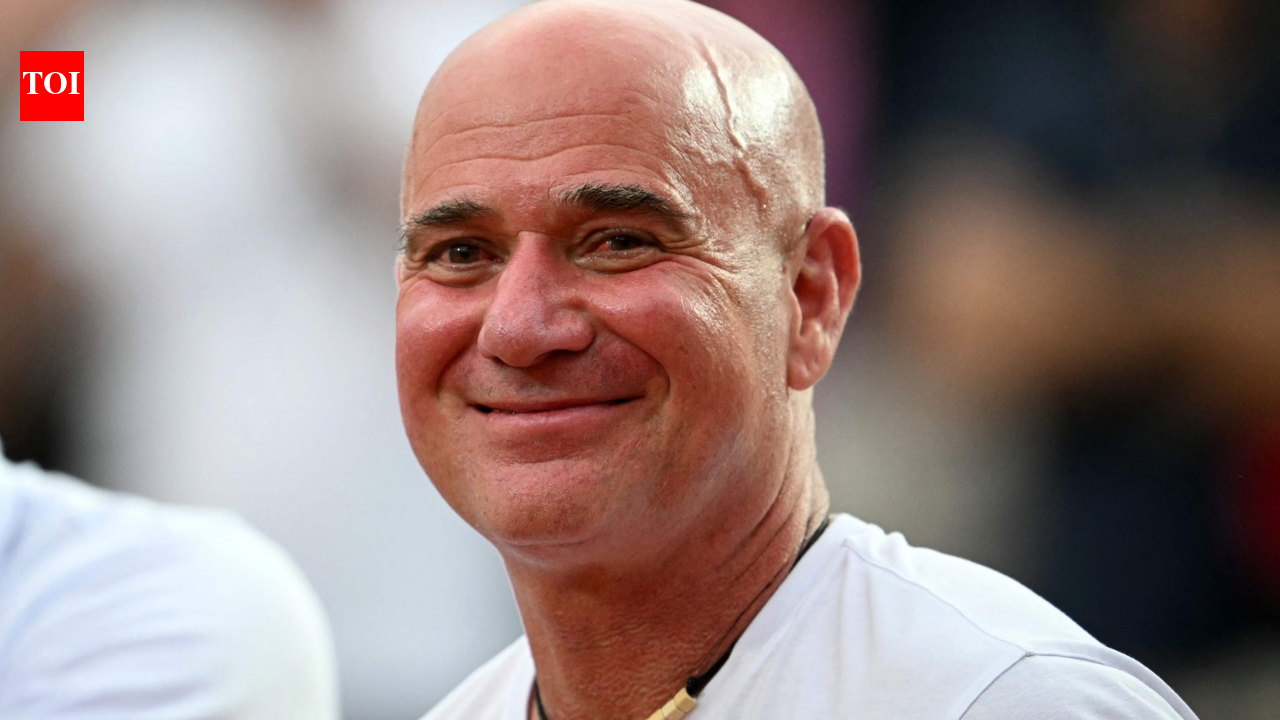
Andre Agassi became one of tennis’ biggest stars despite saying he hated the sport he played for most of his life. The eight-time Grand Slam champion and 1996 Olympic gold medallist was pushed into tennis by his father, Mike Agassi, when he was very young. His childhood training included a powerful ball machine he called “The Dragon”, which sent balls at about 110 mph. Agassi later wrote in his autobiography Open about the fear, pressure and anger he carried from those years. Yet he went on to become world No. 1, complete a career Grand Slam and build a new purpose through education.
How did Mike Agassi turn Andre Agassi’s childhood into a life of tennis
For Andre Agassi, tennis was never simply a childhood game. His father, Mike Agassi, wanted one of his children to become a great tennis player and pushed Andre harder than most young players could imagine.Mike had been an Olympic boxer for Iran and brought the same strong approach to training. He built a tennis court at the family home in Las Vegas and made Andre spend long hours hitting balls. The young player was expected to keep going even when he was tired or wanted to stop.The most memorable part of that training was “The Dragon”, a modified ball machine that Mike made more powerful. It could send tennis balls towards Andre at about 110 mph. Sports Illustrated, quoting Agassi’s account in Open, described how frightening the machine was for the seven-year-old.Agassi later explained his father’s thinking in Open:“My father says that if I hit 2,500 balls a day, I’ll hit 17,500 balls a week, and at the end of one year I’ll have hit nearly one million balls. He says numbers don’t lie. A child who hits one million balls a year will be invincible.”For Mike, the numbers meant progress. For Andre, the endless practice became a source of fear and frustration. He was becoming better at tennis, but he was not developing a love for it.That conflict stayed with him for years. In Open, Agassi put his feelings into one of the most famous lines from the book:“I play tennis for a living even though I hate tennis, hate it with a dark and secret passion and always have.”The words were striking because they came from a player who would eventually become one of the most successful men in the history of the sport.
Why did Andre Agassi’s rebellion hide a much deeper struggle
By the time Andre Agassi reached his teenage years, tennis had already shaped almost every part of his life. At 13, he was sent to Nick Bollettieri’s tennis academy in Florida, where he trained alongside other young players hoping to reach the professional tour. The ATP Tour confirms that Agassi was sent to the academy at that age and turned professional at 16 in 1986.His appearance soon made him stand out. Long hair, bright clothes and a rebellious image made Agassi look like someone who wanted to challenge the traditional image of tennis.But there was a reason that rebellion mattered so much to him.For years, other people had decided what his life should look like. His father decided how much he should train. Tennis decided where he would travel. Coaches decided how he should play. The teenager’s loud style gave him a way to show that there was still a part of his life he could control.The pressure did not disappear after he became a professional. In fact, Agassi later said he had taken his father’s voice and expectations into his own mind.“I’ve internalized my father-his impatience, his perfectionism, his rage. I no longer need my father to torture me. From this day on, I can do it all by myself.”That pressure existed alongside major success. Agassi won his first Grand Slam at Wimbledon in 1992, followed by the US Open in 1994 and the Australian Open in 1995. He also won Olympic singles gold in Atlanta in 1996. By the end of his career, he had collected eight Grand Slam singles titles. Olympedia lists his eight major titles and Olympic gold medal.Still, winning did not automatically make him happy.
How did Andre Agassi rebuild his career after falling to No. 141
Agassi’s career later reached a point where the champion everyone knew seemed to be disappearing. In November 1997, his ranking dropped to No. 141. Just two years earlier, he had been world No. 1.The fall was not only about rankings. Agassi had lost his direction and needed to decide whether he still wanted to keep playing.Instead of walking away, he started again at a much lower level. He played Challenger events, where the crowds were smaller and the conditions were far removed from the big stages where he had once been a star.The ATP Tour describes that period as the beginning of his comeback. After reaching No. 141, Agassi finished 1997 by playing Challenger events and then climbed back to No. 6 in 1998.The biggest moment of that comeback came at the 1999 French Open.Agassi won at Roland Garros and completed the career Grand Slam, meaning he had now won all four major singles tournaments. His list already included Wimbledon, the US Open and the Australian Open. The French Open was the missing piece.Winning it changed how his career was viewed. He was no longer simply the talented player with the flashy clothes and huge personality. He had shown that he could fall a long way and still find a way back.That comeback also gave Agassi a different relationship with tennis. He was no longer simply following the path his father had created for him. He had gone through the worst part of his career and chosen to continue.
How did Andre Agassi find a new purpose with Steffi Graf and education
Away from the court, Agassi eventually found another part of his life that mattered to him deeply: education.He established the Andre Agassi Foundation for Education and later launched the Andre Agassi College Preparatory Academy in Las Vegas. The ATP Tour says the school opened in 2001 as a public K-12 charter school serving at-risk young people in his hometown.Agassi’s work with children gave his success a purpose beyond tennis. Instead of using his name only to celebrate what he had achieved, he used it to help young people get opportunities he felt he had missed.His personal life also changed. He married Steffi Graf in 2001. Graf is one of the greatest women’s tennis players ever, with 22 Grand Slam singles titles. Together, Agassi and Graf have continued to support education and charitable work.That change in outlook is reflected in another line from Agassi’s Open:“It’s no accident, I think, that tennis uses the language of life. Advantage, service, fault, break, love, the basic elements of tennis are those of everyday existence, because every match is a life in miniature.”There is a clear link between that thought and Agassi’s own journey. His life had its advantages and faults, its wins and losses, and one major comeback after another.The boy who once wanted to escape tennis eventually became one of its greatest champions. But his story is not simply about learning to love the sport.It is about taking control of a life that had been planned for him.Andre Agassi did not choose tennis as a child. His father chose it for him. Yet after years of pressure, success, failure and a dramatic comeback, Agassi found ways to decide what tennis would mean to him.He finished his career with eight Grand Slam titles, an Olympic gold medal and a career Grand Slam. But his work in education became another important part of what he left behind.His story is inspiring because the difficult beginning did not have to decide the ending. Agassi turned the sport that once represented pressure into a platform for achievement and helping others. That shift, more than any single trophy, explains why his story still carries meaning.