








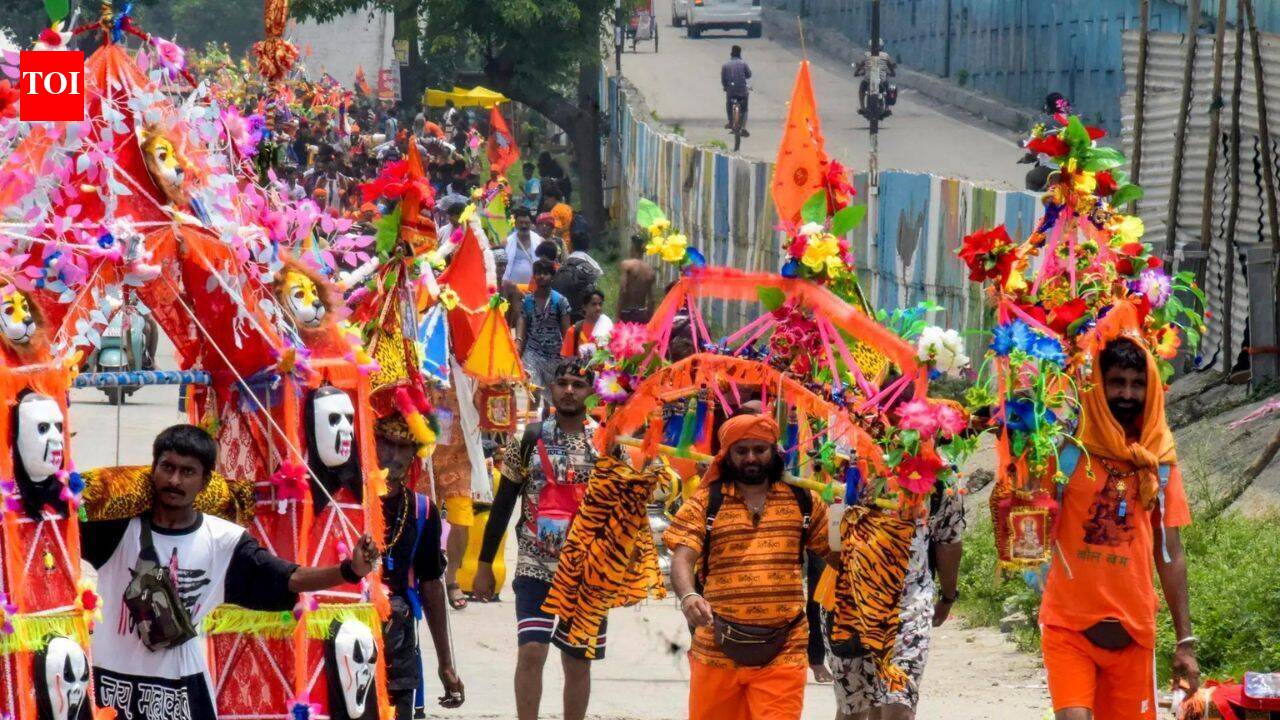

Every year, during the holy month of Shravan, millions of saffron-clad devotees set out on one of the world’s largest annual pilgrimages—the Kanwar Yatra. Carrying beautifully decorated kanwars on their shoulders, they walk hundreds of kilometres to fetch the sacred waters of the Ganga from revered ghats such as Haridwar, Gangotri, Gaumukh, Sultanganj, and other holy places. The water is then offered to Lord Shiva in temples across the country, especially on the auspicious occasion of Shravan Shivratri.In Bihar and Jharkhand holy water is offered in Deoghar temple. In Bengal, the holy water is fetched from Ganga Sagar and Ganga in Mayapur Dham. In Madhya Pradesh, Gujarat and Maharashtra the hole water is fetched from river Narmada. These are only few examples. Similarly, holy water is offered to Lord Shiva in different temples of that city or area.To an outside observer, the Kanwar Yatra may appear to be merely a religious procession. In reality, it is a remarkable confluence of faith, endurance, social harmony, and human compassion. It is a living tradition that demonstrates how spirituality can inspire discipline, self-sacrifice, and collective responsibility.The origins of the Kanwar Yatra are rooted in ancient Hindu traditions. Mythological narratives recount that during the Samudra Manthan (the churning of the ocean), Lord Shiva consumed the deadly poison halahala to save the universe. To ease its burning effect, the gods offered him sacred water from the Ganga. Since then, offering holy water to Shiva has become an enduring act of devotion. Another tradition associates the yatra with Lord Parashurama, who is believed to have carried Ganga water to perform jalabhishek of a Shiva Linga. Regardless of the legend, the symbolism remains constant: the journey is one of purification, gratitude, and surrender.The pilgrimage is physically demanding. Many pilgrims walk barefoot under the scorching sun, through rain and humidity, covering distances that often exceed two hundred kilometres. They abstain from intoxicants, follow strict codes of conduct, maintain personal discipline, and devote themselves to prayer and chanting. The journey thus becomes a form of spiritual tapasya, where the hardships of the body strengthen the resolve of the mind.One of the most inspiring aspects of the Kanwar Yatra is the spontaneous outpouring of public service that accompanies it. Along the pilgrimage routes, thousands of voluntary camps provide free meals, drinking water, medical aid, resting places, and emergency assistance. Individuals, families, community organisations, and religious institutions work side by side to serve complete strangers. Their generosity transforms highways into corridors of compassion and reminds us that service to humanity is itself a form of worship.Equally noteworthy is the sense of equality and brotherhood that the pilgrimage nurtures. On the road, distinctions of wealth, caste, occupation, region, education, social status and even gender recede into the background. The pilgrim’s saffron attire becomes a symbol of shared purpose rather than individual identity. Farmers walk alongside professionals, students beside labourers, and people from different regions and caste and linguistic backgrounds greet one another with the common salutation, “Bol Bam or Bam Bhole.” Such moments reaffirm the idea that faith has the power to unite where social divisions often prevail.The Kanwar Yatra also generates significant economic activity. Small businesses, transport operators, roadside vendors, artisans, and local markets benefit from the influx of pilgrims. Temporary employment opportunities emerge along the routes, while local economies experience a seasonal boost. When managed responsibly, the pilgrimage contributes not only to cultural life but also to livelihoods.At the same time, an event of such enormous scale presents genuine challenges. Traffic congestion, crowd management, public safety, sanitation, and environmental protection require careful planning and close cooperation between government agencies, civil society, and the pilgrims themselves. Isolated incidents of indiscipline should not be allowed to overshadow the devotion of millions who undertake the journey peacefully. Equally, they should remind us that religious observance carries with it a responsibility to uphold patience, respect, and civic discipline.Environmental stewardship deserves special attention. The spirit of the pilgrimage is inseparable from reverence for nature. Rivers regarded as sacred must also be kept clean through responsible waste disposal, reduced use of single-use plastics, and environmentally conscious practices at camps and temples. Protecting the Ganga is not merely an ecological necessity; it is an extension of the very faith that inspires the pilgrimage.In an increasingly fragmented world, where social and ideological divisions often dominate public discourse, the Kanwar Yatra offers a different lesson. It reminds us that faith is not confined to rituals alone. It flourishes in shared hardship, selfless service, mutual respect, and collective hope. Every step taken by a pilgrim echoes a timeless truth: spirituality acquires its deepest meaning when it strengthens bonds between people.The Kanwar Yatra is therefore far more than an annual religious event. It is a celebration of India’s living civilisational heritage, where devotion walks hand in hand with compassion, discipline, and brotherhood. Its enduring message is simple yet profound—that the journey towards the Divine is also a journey towards one another
Disclaimer: Views expressed above are the author’s own.