






Australian universities have long histories of passionate, provocative activism that uses protest to turn attention to injustice.
This week though, the Royal Commission on Antisemitism and Social Cohesion turned the mirror on the anti-Israel protest movement itself and the picture reflected back was often ugly.
Jewish staff and students have told the antisemitism royal commission about being targeted by pro-Palestine activists on campus. (Supplied: Royal Commission on Antisemitism and Social Cohesion)
The commission heard repeated examples of activism crossing the line into racial and religious vilification.
Jewish students and staff spoke of their distress at being individually targeted on the basis of their identity as the protest movement blamed them for the actions of the state of Israel.
“This is antisemitism, unambiguously,” Melbourne University acting vice-chancellor Glyn Davis said.
“[It is the] conflation of the Jewish identity with the actions of a nation state.”
For sections of the Jewish community, those admissions were too little too late, with some saying they had been sounding the alarm about antisemitism well before the protest movement stormed campuses in 2024.
Jewish groups raised concerns about antisemitism during pandemic
Jeremy Leibler, from the Zionist Federation of Australia (ZFA), said he started raising concerns with vice-chancellors about rising antisemitism on campus during the pandemic.
“I had examples of a gay law student at Melbourne University that was wearing Star of David around his neck and was told that they were not welcome in the LGBTQ+ group because they were a Zionist,” Mr Leibler told ABC News.
Mr Leibler said many of these young students were progressive and not necessarily hostile to critiques of the state of Israel.
“Criticism of Israel is entirely legitimate and, by the way, these kids are very comfortable having Israel as a state criticised,”
Mr Leibler said.
“Most of these Jewish kids are very progressive, you know, left-wing Jews that are critical of the government.”
He said Jewish students felt increasingly isolated and it was difficult even to report what had happened to them on campus.
“The word racism is a complex question in terms of antisemitism because Jews are both a religion and a nationality. It doesn’t fall squarely into racism; you’ve black Jews, white Jews,” Mr Leibler said.
“There wasn’t even a drop down in the complaints process to actually describe the conduct as antisemitism.”
Jeremy Suss from the Australasian Union of Jewish Students says universities have failed to protect students from intimidation and violence. (Supplied: Royal Commission on Antisemitism and Social Cohesion)
The commission heard that in an effort to convince vice-chancellors to act, the Australian Union of Jewish Students (AUJS) commissioned a survey to quantify antisemitism.
It found 64 per cent of Jewish students experienced antisemitism and that 57 per cent reported hiding their identities on campus.
This week, AUJS president Jeremy Suss told the royal commission the universities had lost sight of what ultimately mattered: student safety.
“What we’ve seen very clearly, is that universities have had a long time to act on this issue and the most part, they really haven’t,” he told ABC News.
“And university should be a place where every student can get on with their study and not have to face intimidation, not face violence.”
University encampments brought new tension
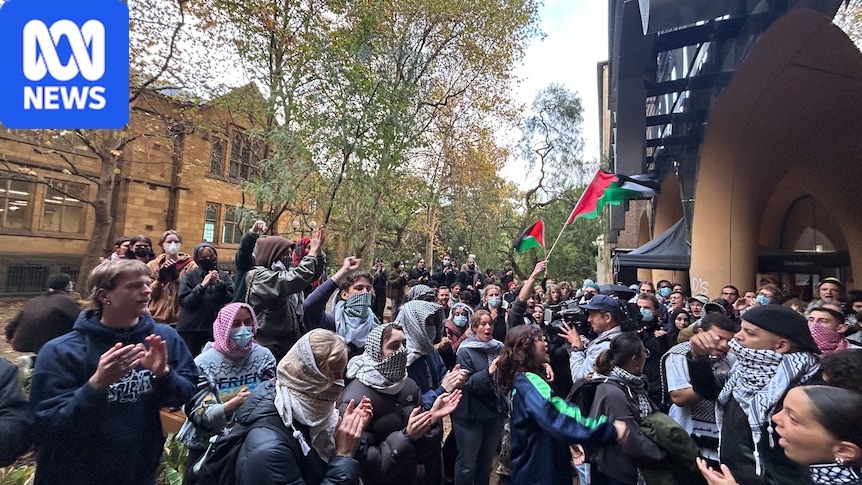
In 2024, protest camps that had been set up across universities became a hotspot of tensions, as pro-Palestine activists campaigned against Israel’s sustained military campaign in Gaza, following the October 7 Hamas attack against Israeli civilians.
Some months-long encampments were populated by a mix of students and outside activists.
The royal commission was told universities were warned outsiders, particularly in Sydney and Melbourne, would bring their protests from CBD locations onto inner city campuses. (ABC News: Angus Delaney)
In May, the peak standards body for the tertiary sector wrote to universities urging them to implement measures to block outsiders from campus, including restricting access for non-students and calling police.
“The introduction of outside actors … saw a much more aggressive, heated and personalised expression of protests and ideas,” Dr Mary Russell from the Tertiary Education Quality and Standards Agency said.
“Particularly personalised against Jewish students on campus and staff.”
Mr Leibler said in this atmosphere, hostility to individual Jewish students and staff was turbocharged and many felt abandoned by university administrations.
“There was a very clear view formed as to which parts of society were the oppressed and which parts of society were the oppressor, and you needed to pick a side,” said Mr Leibler.
“Jewish students were put into the category of the oppressor, either by virtue of their Jewish identity and connection to Israel, but also from classic antisemitic tropes.”
Jeremy Leibler says he raised concerns about antisemitism on university campuses years ago. (ABC News: Rosa Ritchie)
The commission heard most universities were caught flat-footed as tents set up in common areas of campus, despite similar protests in America featuring in the news.
“We didn’t anticipate an encampment,” University of Sydney vice-chancellor Mark Scott said.
“It hadn’t been part of the protest movement history.”
Both the University of Sydney and the Australian National University apologised for their initial light touch approaches, which saw the encampments drag on for months.
There were several confrontations during an encampment at Monash University in 2024. (ABC News: Michael Lorigan)
The Jewish community contrasted the inaction with Monash University’s vice-chancellor Sharon Pickering, who was quick to crack down on her encampment after it emerged there were signs saying Zionists were not welcome on campus.
“No-one was perfect, but it was a completely different world when the leadership of universities were prepared to very clearly take a stand and send signals to what they considered acceptable and unacceptable behaviour,” Mr Leibler said.
The chancellor of Western Sydney University, Jennifer Westacott, also broke ranks with her colleagues and accused leaders of hiding behind academic freedom to allow placards calling for the deaths of Jews.
In an email to University of Sydney staff after his appearance, Professor Scott said the university “wanted to reaffirm our support for the Jewish community”.
“Since October 2023, we have taken significant steps to deliver meaningful change. We have engaged and consulted deeply with the Jewish community and worked assiduously across the University to ensure we have the right foundations to ensure safety and wellbeing for all,” Professor Scott wrote.
University of Sydney vice-chancellor Mark Scott told the royal commission he did not anticipate the prolonged student encampment on his campus. (ABC News)
The commission also heard other universities had already made significant reforms that would make protest encampments unlikely to occur again, with more change on the way.
Universities as a place of civic debate
Universities must now redefine the balance between their duelling commitments to allow protest, while ensuring the safety of staff and students.
Finding a balance that pleases all will likely be impossible, with both sides still locked in dispute over the meaning of key protest chants.
Yasmine Johnson, a co-convener of Students for Palestine, who is Jewish and helped organise the Sydney encampment, said the idea that the protests created fear for people was “farcical”.
She said chants like “from the river to the sea, Palestine will be free” are not expressions of hate or call for genocide, as some in the Jewish community have argued.
Members of the Jewish community have repeatedly labelled the chant as antisemitic, while Prime Minister Anthony Albanese has said it is incompatible with a two-state solution.
“The idea that a call for freedom is a racist call for genocide is a smear on the Palestine movement,” Ms Johnson told the hearings.
Yasmine Johnson says it is farcical to suggest protests by Students for Palestine have created fear.
Ms Johnson told the commission history showed violence could be justified in resistance movements and defended the encampments.
“What we’ve heard … so far is day after day after day of evidence which conflates legitimate anti-genocide, pro-Palestine activism with genuine antisemitism which exists in our society,” Ms Johnson said.
“The primary concern in a democracy, when we’re talking about free speech, cannot be simply whether somebody’s feelings will be hurt by something or not.”
La Trobe professor Denis Altman, an advisory committee member with the progressive Jewish Council of Australia, accused universities of shying away from tough but respectful debate.
“We need, in this country at the moment, a mutual recognition that people are hurting,” he said.
The National Tertiary Education Union (NTEU) warned too much power to shut down debate could be abused.
“We should be extremely wary of any proposal that hands managers broader authority to discipline staff for expressing contested political or scholarly views,” said NTEU Victoria president David Gonzalez.
An encampment at the University of Sydney in 2024 lasted for two months. (ABC News: Brooke Chandler)
While some cases of antisemitism are clear-cut, others will require complex judgement calls.
But it is a challenge vice-chancellors will need to tackle, nonetheless.
“Difficulty to strike that balance cannot be used as an excuse to not act,” council assisting Zelie Heger SC said in opening remarks.
“A line can and must be drawn.”