








While the world has been watching China’s rise, Japan has been in the midst of its biggest defence shift since World War II.
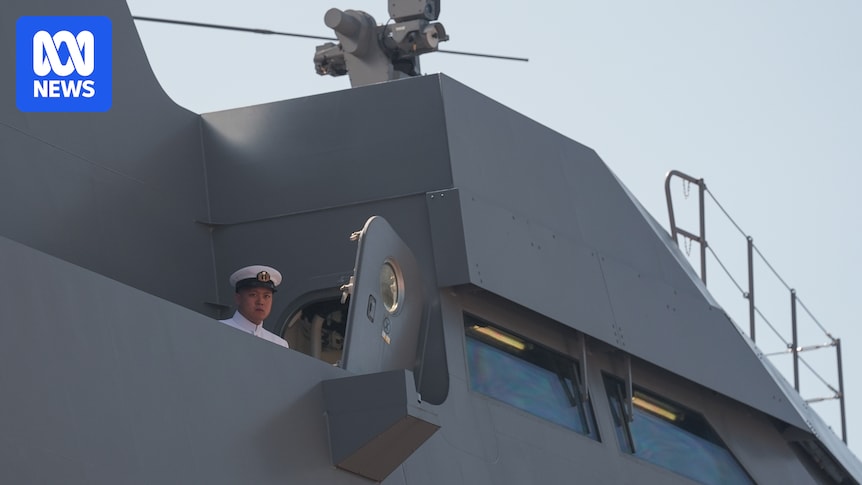
The move is seen as a shift away from the nation’s pacifist constitution, but during a speech on the newly built warship JS Nagara, Yoshida Shinji, the parliamentary secretary to Japan’s defence minister, said it was required to “safeguard” the country’s territory.
“The security environment surrounding our nation is now the most severe and complex it has been since the end of the war,” he said.
Mr Yoshida said the vessel, which has now been officially handed over to Japan’s self-defence force, would help respond to “the increasing demands for surveillance and monitoring during peacetime”.
He then added that “in the event of an emergency”, the JS Nagara had “anti-submarine, anti-air and anti-surface warfare” capabilities.
The warship JS Nagara was recently unveiled. (ABC News: Natalie Whiting)
Australia has already inked a multi-billion-dollar deal with Japan to buy warships, which will be an upgraded version of the same class as the JS Nagara.
Japan is surrounded by nuclear-armed China, North Korea and Russia, and has recently been increasing its defence spending to a record high.
It is also moving weaponry to its outer islands, has a new cybersecurity strategy and is working on a national intelligence agency.
At the same time, it has changed rules to allow it to sell military equipment to certain countries, with the Philippines and Indonesia already making deals.
The shift has been welcomed by Australia and the United States but heavily criticised by China.
Japan’s military expenditure
Japan’s defence spending has been growing steadily for more than a decade, with the latest budget allocating 9 trillion yen ($80 billion), which is close to its goal of 2 per cent of GDP.
The country has been under pressure recently from its only official ally, the US, to increase defence spending while also facing concerns that Washington’s attention is being drawn to the Middle East.
The defence expenditure also comes amid mounting tension in the region, with Japanese and Chinese coastguards again facing off in waters near Taiwan this month.
In response to questions from the ABC, Foreign Minister Motegi Toshimitsu said China’s increasing defence spending and its “rapidly expanding” nuclear and missile capabilities were a concern to Japan.
Japan spends enough on its own military to sustain a sizeable defence industry. (ABC News: Natalie Whiting)
China’s ballistic missile test in the Pacific last week is the latest source of tension.
“China is increasingly expanding and intensifying its military activities in the vicinity of Japan,” Mr Motegi told the ABC.
“These military developments, combined with a lack of transparency, are a matter of serious concern not only to Japan but also to the international community.”
He said against the backdrop of “an increasingly severe security environment”, Japan is “developing the minimum defence capabilities necessary to protect the lives and property of our citizens and to properly safeguard our territory, territorial waters and airspace”.
China warns Japan is becoming a ‘powder keg’
The Chinese government has repeatedly criticised Japan’s defence shift, saying it represents a “neo-militarisation”.
State-run media has said Japan, “once an aggressor”, has failed to reflect on its “wartime crimes”.
Japan is seeking to build defence supply chains in Asia that do not rely on the United States. (ABC News: Natalie Whiting)
Diplomatic relations between Beijing and Tokyo have been at an historic low since Japanese Prime Minister Takaichi Sanae indicated an attack on Taiwan could prompt a response from Japan.
“Japan is becoming a powder keg for the Asia-Pacific region with its accelerated remilitarisation,” said Chen Xi, a spokesman for China’s Ministry of National Defense.
“The Japanese side has repeatedly peddled the so-called China military threat narrative, deliberately stoked confrontation, and created security anxieties.
“The reason it has done all these things is to fabricate excuses for breaking free from restrictions on its defense forces and for seeking massive military build-up.”
Mr Motegi also said China’s “narratives” about Japan “run counter to the truth” about the country’s policies and positions.
“Japan’s post-war trajectory as a peaceful nation will remain unchanged,” he said.
“We believe that Japan’s approach and actual actions, as well as its contributions to peace and prosperity in Asia and the wider world, have earned the trust and support of many nations.”
Australia and the Philippines have welcomed the move, while Indonesia signed a landmark defence cooperation agreement with Japan in May.
Protesters aren’t on board with Japan’s shift
While Japan makes its case on the international stage, back home, the move has prompted protests and backlash.
Anti-war protesters congregate in Tokyo. (ABC News: Natalie Whiting)
Tens of thousands of people have attended anti-war demonstrations in recent months, concerned about the changes to the military export rules and the government’s discussion of altering the country’s pacifist constitution.
The constitution restricts Japan from having a full military or deploying internationally. The nation instead maintains a “self-defence force”, which is designed to only respond to a threat at home.
“The country can defend itself even without being completely defenceless,” protest leader Furukawa Kanata said at a recent demonstration outside the Diet, Japan’s parliament.
“However, in this case, they are trying to make a profit by selling weapons designed to kill people.”
Interpretations of what constitutes a threat, and whether Japan could respond to a regional issue in an act of “collective self-defence” remain fiercely contested by politicians and the general public.
Anti-war protesters are concerned about the changes to Japan’s military export rules. (ABC News: Natalie Whiting)
Ms Takaichi’s government has flagged the possibility of revising Article 9 of the constitution, but requires support from both houses of parliament and a national referendum.
And there are plenty of people, like Furukawa Kanata, who would vote against it.
“I believe the Japanese Constitution was originally drafted as a result of the reflections following the Second World War,” he said.
“To overturn that from its very foundations is, in my view, extremely dangerous.”