




Anxiety has struck Australian motorists again as the price of oil has risen dramatically over the past 24 hours.
If sustained, analysts say this could lead to more hip pocket pain at the pump.
On his Truth Social page overnight, US President Donald Trump announced from this point forward the United States would be known as “the guardian of the Hormuz Strait”.
“As a matter of FAIRNESS, [the US] will be reimbursed, at the rate of 20 per cent on all cargo shipped, for any and all costs necessary to do the job of providing safety and security to this very volatile section of the World,” he said.
“The process and formation will begin immediately.”
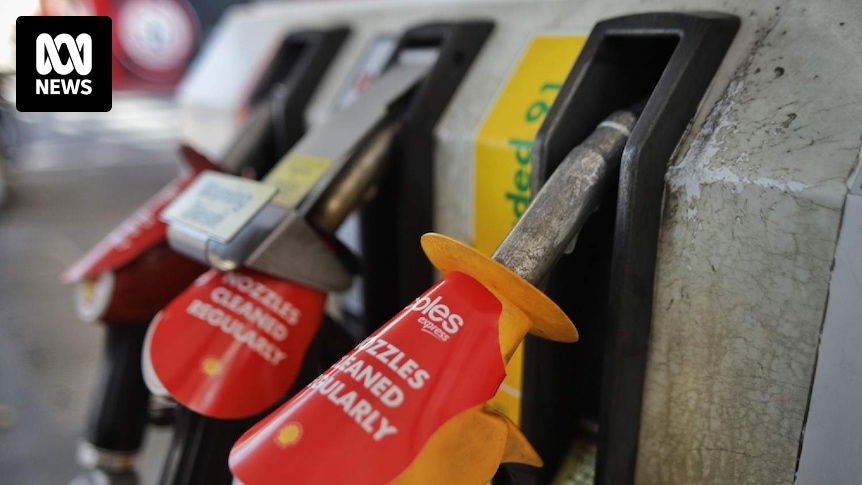
The price of oil has risen again as tensions in the Middle East continue. (ABC News: Chris Taylor)
The price of West Texas Intermediate (WTI) crude oil rose 5 per cent immediately following the post.
By midday, trade in Asia saw the price of WTI gain a further 1.4 per cent to $US79.28.
Brent crude is now up roughly 10 per cent since late afternoon trade Monday (AEST) to $US84.19.
Middle East tensions at centre of oil spike
The price of oil had fallen in recent weeks to levels not seen since before the Iran war began.
Oil tankers and cargo ships line up in the Strait of Hormuz, seen from Khor Fakkan, United Arab Emirates, in March. (AP: Altaf Qadri)
The drop in price was helped by the signing of a Memorandum of Understanding (MOU) between the US and Iran, although did not come without criticism.
“The problem with the MOU was that it was deliberately vague,” said Middle East analyst Will Todman.
“It allowed both sides to interpret it as they wished, and I think that is what has led to this breakdown over the past week or so.“
The price of oil began moving up late last week and into the weekend as Iran announced once again it was closing the Strait of Hormuz.
The key waterway sees roughly 20 per cent of the world’s oil and gas supplies flow through it, meaning once it is closed the higher prices are felt around the world.
“It’s logical that oil goes up because obviously there are [always] fears that Iran will close or partially close the Strait of Hormuz,” said Commsec Equity Market Strategist James Gruber.
Analysts also say Mr Trump’s Truth Social post has exacerbated already existing Middle East tensions.
Analysts say US President Donald Trump’s social media posts are exacerbating tensions with the Middle East. (Reuters: Leah Mills)
“With Trump one never quite knows how seriously to take such pronouncements, but Gulf allies would not be pleased with this plan and it almost certainly violates international law,” wrote National Australia Bank senior analyst Jason Wong.
“The 20 per cent levy would add about $US16 to the cost of every barrel of oil passing through the Strait on a typical supertanker.
“It remains to be seen whether the plan will stick, probably not, and whether it is merely a negotiating tactic aimed at getting Iran to pause its military strikes on shipping in the area.“
Where to for oil from here?
Commsec’s James Gruber said the price of oil will continue to rise as commodities traders get increasingly anxious about global oil supplies.
Fuel prices on March 18 in Sydney after oil supply was impacted by the Iran War. (ABC News: Chris Taylor)
“The risk with oil going forward is that if there is this closure of the Strait of Hormuz, and Trump has acknowledged this, that inventories for oil are extremely low across the developed world,” Mr Gruber said.
“If the Strait [closure continues] how long can developed nations, including Australia, last without that oil is the big question.
“Some analysts suggest it could be four to six weeks before we start having to do things like rationing.”
Motoring group the NRMA said recent events in the Middle East have created an air of “chaos” affecting financial markets.
“Chaos is the new norm with the Middle East,” the NRMA’s Peter Khoury said.
“The markets have started to price in the chaos.“
Mr Khoury noted that regional benchmark oil prices, including Tapis crude, have risen in the past 24 hours.
Tapis is the bulk of unrefined oil Australia seeks to purchase for its remaining domestic refineries, which has risen $1.70 in the past 24 hours, and is still going up.
Wholesale prices, which are the prices petrol stations pay for their refined oil in the form of petrol or diesel, have “held relatively stable” so far, Mr Khoury noted.
He warned petrol prices for motorists would increase if the “chaos continued”.
However, the Royal Automobile Club of Queensland (RACQ) is not concerned about the latest oil price surge.
Principal economic and affordability specialist Ian Jeffreys told the ABC, “at the moment we’re not expecting a price shock like we saw back in March and late February.”
He did note, however, that the tax concessions on diesel and petrol are due to be fully ended by August.
“Certainly the timing is very unfortunate,”
he said.
Tradies and farmers in the firing line
The price of diesel has also risen, impacting tradies and farmers. (Supplied: Lara Pacillo)
For businesses, the price of diesel has risen a further 1.4 per cent as of midday AEST, while natural gas for August delivery has fallen 0.4 per cent to $2.89 (United States Dollars per Million British Thermal Units).
The price of urea fertiliser rose to $US415.50 a tonne on Monday, up 7.23 per cent, and is now up 12.30 per cent this month alone.