







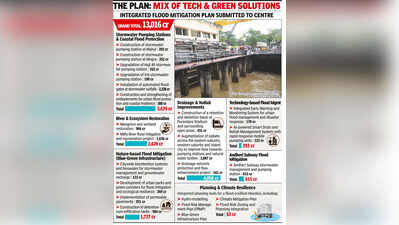
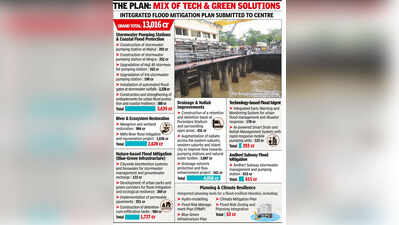
Mumbai: The Rs 13,000-crore integrated flood mitigation master plan announced by chief minister Devendra Fadnavis during the ongoing Assembly session on Wednesday combines conventional drainage upgrades with nature-based solutions to tackle Mumbai’s chronic flooding, particularly in low-lying areas.BMC officials said the proposal has been submitted to the Centre and the National Disaster Management Authority (NDMA), which has granted it in-principle approval. A detailed project report (DPR) is now being prepared following multiple rounds of consultations with the NDMA.Comparable in scale to the Rs 13,984-crore Coastal Road project, the flood mitigation plan will be funded with 40% from the National Disaster Response Fund, 30% from the Maharashtra government and the remaining 30% from the BMC.The blueprint has been in the works for over a year. The first NDMA meeting was held on March 12, 2025, followed by site visits and a presentation to Union home minister Amit Shah in June, after which the proposal received in-principle clearance.“The plan proposes a mix of engineering and ecological interventions, with exact locations to be finalised through the DPR. Key measures include upgrading storm-water drains to handle rainfall exceeding 55 mm per hour in vulnerable stretches and at locations where multiple nullahs discharge into a single drain, expanding pumping capacity in flood-prone areas such as Mahul and Mogra, and taking up the next phase of the Mithi river improvement project. Nature-based interventions include detention-infiltration tanks, bio-retention parks, sponge parks and permeable pavements to reduce surface runoff and improve groundwater recharge,” said additional municipal commissioner Abhijit Bangar.The plan goes beyond conventional flood-control measures by introducing nature-based interventions designed to reduce surface runoff and increase groundwater recharge. Officials said permeable pavements are being considered as they can absorb 12-15% of rainwater that would otherwise contribute to waterlogging while also benefiting trees planted along footpaths. Detention-infiltration tanks — underground honeycomb-like structures — will temporarily store rainwater before allowing it to gradually percolate into the ground. The proposal also seeks to address one of the biggest impediments to efficient drainage — plastic waste clogging nullahs and culverts. Officials said interception systems and longitudinal nets are being planned at strategic locations to trap floating garbage before it blocks storm-water channels.Authorities acknowledged there is “no magic wand” to eliminate flooding in Mumbai, but said a series of targeted interventions, backed by scientific modelling and upgraded drainage infrastructure, could substantially reduce the frequency and severity of waterlogging.