






Every remake has to answer the same quiet question before it does anything else. Whose version of the old game is it rebuilding? The one that actually shipped, warts and all, or the one people carry around in their heads years later, which is usually a good deal kinder. The two are rarely the same game.When I put a version of that question to Nicolas Lopez, the engine architect on Assassin’s Creed Black Flag Resynced, he answered by talking about his own shelf. His favourite console is the original PlayStation, and every game he loves is on it. But when he replays them, they’re never quite what he kept in his head. Not worse, exactly. Smaller.He thinks Black Flag does the same thing to people. They remember the 2013 game as brighter and smoother and bigger than it actually was.He’s not wrong about the affection. When Assassin’s Creed IV: Black Flag landed in 2013, it did something the series hadn’t managed before, turning Edward Kenway loose on an open Caribbean where the sailing mattered as much as the stabbing. Lopez remembers not being able to picture it when it was announced. He knew what Assassin’s Creed was. He knew what a pirate game was. He couldn’t imagine the two together, and he thinks that’s what people ended up loving, a game that didn’t fit the shape they expected.It’s the one a lot of people name as their favourite Assassin’s Creed, and I’m one of them. I put dozens of hours into it, most of them at the wheel of the Jackdaw rather than on any destined path. Coming back thirteen years on, the strange thing isn’t how much has changed. It’s how much I trusted my memory of a game I hadn’t touched in over a decade, and how little that memory matched the footage.For Lopez’s team, that gap wasn’t a problem to fix. It was the assignment. They didn’t set out to rebuild the game. They set out to rebuild the memory of it, and where the two disagreed, they went with the memory.That idea sits under everything in Resynced, and it also explains a feeling I couldn’t place at first, in the early preview and now deeper into the full release: I recognised this Caribbean straight away, and yet I’d never seen it look like this. What felt like a contradiction was the plan all along.
Memory is a better art director than the original ever had
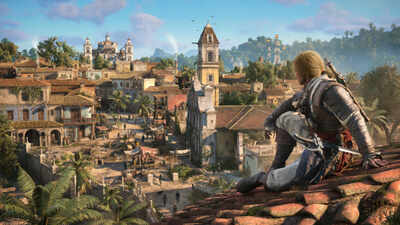
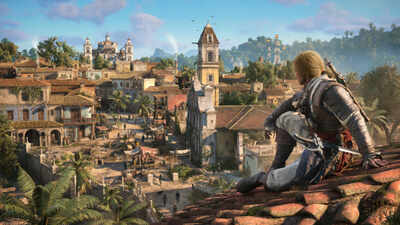
Jussi Markkanen, the game’s technical director, explained how much work went into staying faithful. The 2013 debug build ran on the studio floor for the entire production, so any location, quest or cutscene could be pulled up and checked against the new version. Many of the people doing the checking had shipped the original. They knew the game inside out.But faithful didn’t mean identical, and the colour is where that shows. The original Caribbean leaned grey and brown, partly the hardware of the time, partly the fashion of it. Resynced warms the palette and makes it more vibrant, deliberately. Markkanen says the feedback now is that the colours are exactly as vibrant as players remember. They aren’t. The vividness is new. Players are remembering a game that never looked this rich, and the remake has made that memory accurate after the fact.I noticed it from the other side. The colour is stronger than the original, but it doesn’t register as a change. It registers as the game agreeing with you. Havana is the clearest tell, its dull browns swapped for streets that finally look as warm and alive as I’d always pictured them, even though I know the original never rendered them this way.Holding that line took discipline, because the easy path ran the other way. Modern rendering makes photorealism almost the default now, and photorealism isn’t what Black Flag looks like. Markkanen says the team felt no pressure to make Resynced more serious or realistic to match where the series has gone since. If anything the harder job was the opposite: keeping it fully modernised but still stylised, holding the slightly romanticised look that was always part of it, rather than letting the new tech sand it into something greyer and more grown-up.That’s the flattering half. The harder trick sits underneath it, in the parts of the old game that were never really assets at all. A lot of what people love about Black Flag came from what the 2013 hardware couldn’t manage. Physically based rendering didn’t exist. Volumetric fog was new enough that Black Flag was one of the first Ubisoft games to use it. Water was simpler. Those limitations became part of the game’s identity, the way the fog in Silent Hill went from a way of hiding draw distance to being the reason the town works. You can’t copy a limitation, so the team looked for the intention behind it, and having so many of the original artists still around, Lopez says, is what made that possible.The clearest example is one almost nobody will notice: the curve of the Earth. In the original, ships and islands sink below the horizon as you sail away rather than just shrinking, which gives the world a sense of real size. Modern hardware could render all of it. It would also, Markkanen says, stop feeling like the same sea. So they rebuilt the effect on purpose, and Lopez says recreating it was harder than making it the first time. In 2013 it was a simple formula applied to every mesh. In Resynced it has to fight through virtual geometry and GPU-driven pipelines, a modern rendering stack that resists being told to hide things. The team spent real effort rebuilding an old constraint, for a detail that lives out past the horizon where hardly anyone looks.
The sea had to lie to feel true
The same care turns up on the water, and it matters more here than it ever did in 2013. The sea was always Black Flag’s escape, the thing between missions. In Resynced it’s closer to the main event, with more of the world built around it, more reason to be out on it, and a level of detail the original never spent on the thing you looked at most. It’s also a harder problem than the rest, because everyone thinks they already know how the sea should behave.“There’s an uncanny-valley aspect, because everyone has seen water,” says Kris Kirkpatrick, the water tech expert, who also worked on the original and came back a decade later. People believe they know when water looks right and when it looks wrong, even if they’ve never studied it.His approach isn’t to chase realism. It’s to art-direct the simulation. There’s no split in Resynced between a physics ocean and a good-looking one. The waves carry their own physics, and Kirkpatrick tunes the heights, speeds and frequencies, balancing how the sailing feels against how the water looks. He can’t tell the physics to stand down because a shot needs to look a certain way. Both have to work at once.Underneath, the swell starts with an FFT system that sets its shape and size, built in layers so the sea can run from a dead calm up to a full storm. On top sits a Beaufort-scale model, the same scale sailors use to grade wind, which fixes how the waves behave in any situation.Shorelines stay calm. Head into open water and the swell builds, weather comes in, and some missions call for conditions rough enough to make a fight harder. It’s the colour and the horizon problem again, moved onto the water: give players the sea they think they sailed, bigger and less repetitive than the real one.Faithful water, Kirkpatrick points out, would be a mistake. A real ocean is more repetitive than people expect. So once the believable base is there, the team starts adding variety and drama. It’s a pirate game, so it gets pirate water.His proudest detail is one you’re not meant to consciously notice: individual bubbles in the foam, built from a bubble map, catching the light. Get close at sunset and they shine. Beneath all of it, a concurrent binary tree does the unglamorous work of tessellating the surface, adding triangles exactly where they’re needed so the illusion holds however close the camera gets, on whatever machine you’re running.The bubbles, for the record, land. The sea was always the reason Black Flag stuck with me in 2013, the part I kept sailing long after the story ran out, and it’s the first thing I went looking for here. I went into the preview half-expecting to be let down by it, another prettier blue backdrop. Well into the full game now, it’s still the thing I keep stopping for.The tech underneath, the tessellation that adds detail where the eye lands, the Beaufort-scale system that takes the ocean from flat calm to open storm, never draws attention to itself. It just gives back the water players think they remember, warmer and rougher than the original could actually render.The storms are where it pays off most. A calm crossing turns without much warning into dropping visibility, the swell throwing the Jackdaw around like it has weight, cannon fire lighting up through the rain, naval combat that had been routine suddenly asking me to change tactics mid-fight. That’s Kirkpatrick’s Beaufort model doing exactly what he described, and from the deck you don’t clock it as a system at all. You just get wet and start improvising.
Still the original Black Flag underneath, and that’s the point
There’s a harder question here, and Lopez doesn’t avoid it. Isn’t a remake, in the end, an admission that the original was never as good as fans insist?Maybe, he says, but the point is what you do with that. He isn’t puncturing the memory, he’s protecting it. You close the gap between what the game was and what people think it was because the belief is the part worth keeping.That instinct runs from the top of the studio. In his note, creative director Paul Fu writes that when the team first conceived Resynced, the important thing was to safeguard Black Flag’s spirit, and signs off calling the whole project a labour of love. It reads like PR until you have spent time with the people under him, at which point it just reads like the brief.That shows most in the moments that serve no purpose beyond atmosphere. A drunk pirate stumbling off the walls of a Havana alley with no quest attached to him, doing nothing but existing, and doing it well enough that I stopped to watch.I asked Lopez what he most wanted players to walk away with. His answer was simple: he wants them to feel like a pirate. In the original the world came in separate loaded chunks. Here it’s one connected space, so you can take the Jackdaw out of Havana, chase down a Spanish ship, and sail back without a single loading screen breaking the spell. It’s a small structural thing that does a lot of quiet work. It’s also the clearest case of the remake improving the fantasy rather than just the resolution.The story holds up its end. Edward Kenway was always one of the series’ best leads, a privateer turned pirate who backs into the Assassin–Templar war out of greed rather than belief, charming and bawdy and a little mournful underneath. Resynced does nothing to dull him. What still lands hardest is Nassau, the so-called Pirate Republic, and the slow collapse of that brief experiment in self-rule as the pressure builds from outside and the cracks open within.The re-recorded and expanded dialogue gives it more modern weight. Markkanen frames the roughly six hours of new content as a chance to tell parts of Edward’s story, and his crew’s, that the original never had time for. Addition rather than revision, which is the whole ethos in miniature.It shows in the harder edges too. Combat that finally asks something of you, and a run of quality-of-life fixes, a crouch button thirteen years late among them, that close the gap between how smoothly you remember the original playing and how it actually did. None of it rewrites Black Flag. All of it depends on the version already in your head.I’m still a long way from the end, so whether it holds all the way is a question I can’t answer yet. And there’s a real tension in it I keep circling. A faithful remake of a 2013 game is still, underneath the new engine, a 2013 game, the same loop of sail, infiltrate, loot, upgrade, repeat, with a few of the old dated edges intact. Whether that reads as comfort or as a ceiling will depend on the player.But it doesn’t undo the intent, which is a generous one. Ubisoft Singapore didn’t try to make a better game than the one you loved. It tried to make the one you loved as good as you remember it being. That’s a harder thing than a straight remaster, and so far it lands more often than not.Assassin’s Creed Black Flag Resynced is out now on PC, PS5 and Xbox Series X/S.