









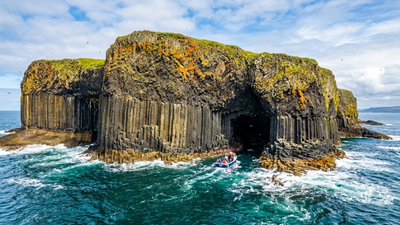
Rising from the Atlantic Ocean on the remote Scottish island of Staffa, Fingal’s Cave is one of the world’s most extraordinary natural landmarks. Carved into towering hexagonal basalt columns formed by ancient volcanic eruptions around 60 million years ago, the cave is celebrated not only for its striking appearance but also for its remarkable acoustics. As waves surge through its cathedral-like chamber, the sound reverberates off the smooth rock walls, creating deep, haunting echoes that have fascinated visitors for centuries. The cave has inspired musicians, writers, artists and scientists alike, earning international recognition as both a geological masterpiece and a cultural icon. Today, Fingal’s Cave remains one of Scotland’s most spectacular natural attractions, where volcanic history, marine forces and human imagination converge in a truly unforgettable setting.
Why does Fingal’s Cave create its haunting natural music
The haunting sounds of Fingal’s Cave are the result of an extraordinary interaction between its volcanic architecture and the Atlantic Ocean. According to research published in the VIEW Journal of European Television History and Culture, the cave’s interior is lined with thousands of hard basalt columns whose smooth, geometric surfaces reflect sound exceptionally well.Unlike softer rock formations that absorb vibrations, the dense basalt repeatedly bounces sound waves around the cave’s long, vaulted chamber. As ocean swells enter the narrow entrance, each crashing wave produces echoes that overlap and linger, creating a complex reverberation that changes continuously with the height of the tide, wind direction and sea conditions.Researchers also note that the cave’s acoustics are shaped by its distinctive cathedral-like proportions, which allow low-frequency sounds to travel deep into the chamber before reflecting back towards the entrance. Rather than producing a single echo, the cave generates layers of resonant sound that can range from gentle humming and rhythmic pulses to thunderous booming during rough weather.This remarkable acoustic phenomenon gave the cave its original Gaelic name, An Uamh Bhinn, meaning “the melodious cave,” long before it became known internationally as Fingal’s Cave. The natural soundscape later inspired composer Felix Mendelssohn’s famous overture The Hebrides, cementing the cave’s reputation as one of the world’s most celebrated landscapes where geology and sound come together in perfect harmony.The acoustic effect has often been compared to music inside a cathedral because the cave’s natural architecture amplifies and prolongs sound rather than absorbing it.
How volcanic eruptions created the giant basalt columns
Fingal’s Cave is part of a much larger volcanic landscape that formed during the opening of the North Atlantic Ocean roughly 60 million years ago. At that time, enormous quantities of basaltic lava spread across western Scotland.As these thick lava flows cooled slowly, they contracted evenly in all directions. This cooling process caused fractures to develop, producing thousands of polygonal columns, most commonly with six sides, a phenomenon known as columnar jointing. Similar formations can be seen at Northern Ireland’s Giant’s Causeway, as both landscapes were created by the same ancient volcanic event.Over millions of years, relentless Atlantic waves gradually eroded the surrounding cliffs while leaving the exceptionally durable basalt columns largely intact. The sea slowly hollowed out the cave, exposing the towering pillars that now resemble the walls of a giant stone cathedral. Some columns exceed 20 metres in height, while others continue beneath the waterline, demonstrating the immense thickness of the original lava flows.
Why Fingal’s Cave became famous around the world
Although local communities had known about the cave for centuries, it gained international fame in the late eighteenth century after naturalist Sir Joseph Banks visited Staffa in 1772. His descriptions introduced the remarkable sea cave to a wider European audience, sparking growing interest among scientists, artists and travellers.The cave’s reputation grew even further after German composer Felix Mendelssohn visited in 1829. Deeply moved by the rhythmic sounds of the Atlantic waves reverberating through the cave, he composed the celebrated orchestral overture The Hebrides (Fingal’s Cave), one of classical music’s most famous works inspired directly by nature.According to the National Trust for Scotland, writers including Sir Walter Scott, Jules Verne, John Keats, William Wordsworth and Alfred, Lord Tennyson also praised the cave’s dramatic beauty. Its name derives from Fingal, the legendary Gaelic warrior featured in James Macpherson’s Ossian poems, adding a rich layer of mythology to its geological significance.
Wildlife and the unique environment of Staffa
While Fingal’s Cave is the island’s best-known attraction, Staffa itself is an important wildlife sanctuary. According to Birding Places, during spring and summer, thousands of seabirds nest on the island’s cliffs, including Atlantic puffins, guillemots, razorbills, fulmars and shags. Grey seals frequently rest along the rocky shoreline, while dolphins, porpoises and even minke whales can sometimes be spotted in the surrounding waters.The island’s nutrient-rich marine ecosystem supports this diverse wildlife, making Staffa an important conservation site as well as a geological treasure. Visitors often combine birdwatching with cave exploration, experiencing both Scotland’s volcanic heritage and its rich coastal biodiversity.
Visiting Fingal’s Cave today
Fingal’s Cave is accessible only by boat, with seasonal tours departing from the Isle of Mull and nearby locations on Scotland’s west coast. Weather conditions play a major role in determining access, as strong Atlantic swells can make landings unsafe.Visitors typically walk across the basalt columns that extend towards the cave entrance before entering the vast interior. Every visit is unique because changing tides, wave conditions and weather continuously alter both the cave’s appearance and its extraordinary acoustics. Early morning and late afternoon often provide the most dramatic lighting, while calm seas allow the echoes within the chamber to be heard most clearly.
Why Fingal’s Cave remains one of Scotland’s greatest natural wonders
Fingal’s Cave is far more than a scenic tourist destination. It represents millions of years of volcanic activity, geological evolution and relentless marine erosion, preserved in one of the finest examples of columnar basalt found anywhere on Earth.At the same time, its haunting acoustics have inspired generations of composers, poets, scientists and explorers, demonstrating how natural landscapes can shape human creativity. Today, the cave continues to stand as a remarkable meeting point of science, history, mythology and art, reminding visitors that some of nature’s most breathtaking masterpieces are created not by human hands, but by the slow and powerful forces of Earth itself.