








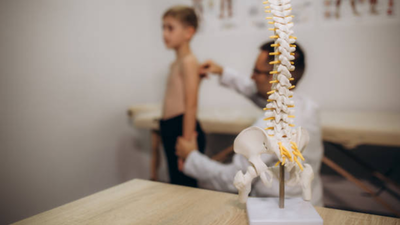
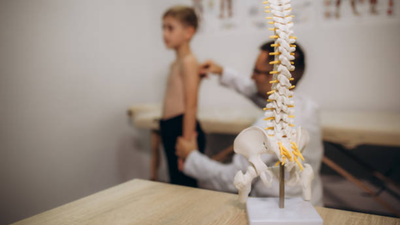
One in 40 to 50 teens may have scoliosis, but many cases are not noticed until the spine twists dangerously. Doctors corrected a nearly 70 degree spinal deformity in a 14-year-old girl from Delhi before it caused irreversible damage.Parents often write off uneven shoulders or a slight bend in their child’s back as a case of poor posture or the weight of a heavy school bag. But for the Delhi girl that seemingly innocuous curve was silently moving into a severe spinal deformity that could have compromised her lungs, affected her heart and permanently changed her quality of life.
What is scoliosis?
A few months ago, her parents noticed the teenager’s back appeared uneven. As the deformity increased rapidly, they rushed her to hospital where specialists diagnosed her to be having Adolescent Idiopathic Scoliosis (AIS). Investigations showed that her spine had already curved by almost 70 degrees – a severity that significantly increased the risk of compression of the lungs and heart if untreated.Worldwide, adolescent idiopathic scoliosis affects nearly 2-3% of children between the ages of 10 and 16, but in the early stages, nearly 90% of adolescents with the condition do not experience pain, allowing the condition to develop without notice. If the spinal curve is greater than 50 degrees it is very likely to continue to progress even after skeletal growth has stopped and increase the risk of chest deformity, breathing difficulties and chronic disability.The child was in the growth phase, which makes the condition particularly dangerous, said Dr Tarun Suri, Senior Consultant & Head, Orthopaedic Spine Surgery, Amrita Hospital, Faridabad. “She presented with a progressively increasing spinal deformity. She underwent evaluation and was diagnosed with adolescent idiopathic scoliosis, and the spinal curve was already approximately 60-70 degrees. And then it became more than a cosmetic problem. The deformity was likely to worsen greatly, and, as she was still growing, could have compressed her lungs and heart. “Permanent complications were avoided by surgical correction.”After a detailed discussion with the family, the multidisciplinary spine team conducted a complex correction of scoliosis with intraoperative neuromonitoring, a sophisticated technique that continuously monitors spinal cord function during surgery, as well as Cell Saver technology that enables collection and reinfusion of the patient’s own blood and minimizes the need for donor blood transfusions.The operation was completed successfully with no neurologic sequels. The teenager did fine and was released in four to five days with excellent correction of her spinal curvature. She’s getting back into her daily routine little by little. Dr. Archit Goyal, Senior Consultant, Spine Surgery, Amrita Hospital, Faridabad said, “Scoliosis is usually diagnosed very late as it does not cause any pain in its early stages. “Parents should never ignore uneven shoulders, such as one shoulder blade more prominent than the other, an uneven waistline, or a rib hump when the child bends forward. These could be the first warning signs of scoliosis. Early diagnosis is followed by prompt treatment and often prevents severe deformity and complex surgery.”Experts recommend at least one scoliosis screening during the adolescent growth spurt, especially between 10 and 16 years of age when the condition progresses fastest. Early detection can often avoid the need for extensive surgery and preserve long-term lung function, posture and mobility.