






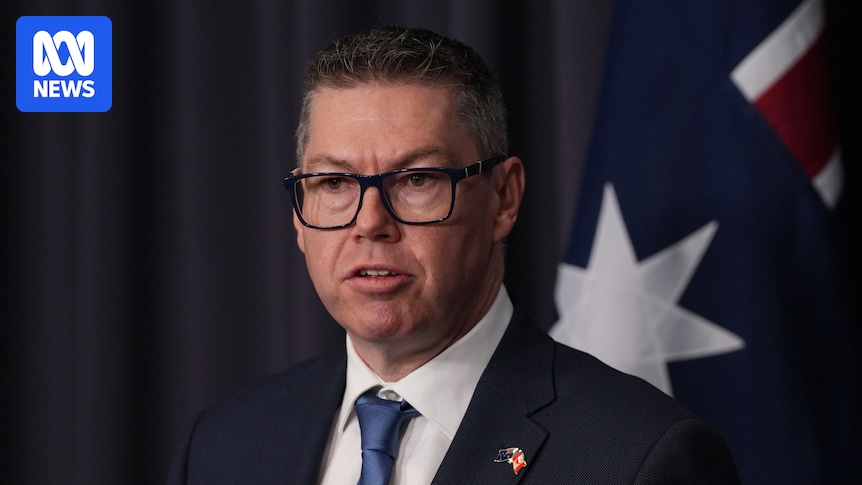
Defence Industry Minister Pat Conroy is set to make an appeal to the Labor faithful to get behind AUKUS, and back Labor as the natural party of defence and national security.
Mr Conroy will also use an address to the National Press Club today to point the finger at the Defence establishment for a “lack of discipline” as the reason behind tens of billions of dollars in cost blowouts on major projects.
The address comes three weeks before Labor’s national conference, which could again see internal tensions within the broader Labor movement come to the fore.
Mr Conroy, who is one of the most senior figures in the party’s left faction, will use the speech to argue that progressive politics and patriotism can be aligned, and national security should be prioritised.
“Progressive patriotism recognises that defending our democracy, sovereignty and way of life is therefore also worth doing, just as much as any other element of what we seek to do as progressives,” he will say according to excerpts of the speech provided to the ABC.
“It means we still stand tall with our great friend and ally — the United States.
“But, at the same time, we can have self-reliance within the alliance — and strategic autonomy.”
The parliamentary Labor Party has firmly backed the AUKUS nuclear submarine pact since it was first raised under the Morrison government, pouring billions into it since taking office.
But it has continually had to push back on concerns about the pact within the Labor Party’s broader membership, including a discussion at the last national conference in 2023.
More recently, Labor MP Ed Husic called for a “rethink” on AUKUS, in the wake of a shift in the pact that saw Australia acquire three in-service Virginia-class submarines, rather than two in-service and one new.
Ed Husic is among those who have been critical of AUKUS. (Four Corners: Mark Hiney)
It is not the first time the government has articulated an ideology of “progressive patriotism” to define its approach to defence, national security and Australia’s place in the world.
Mr Conroy will use the speech to argue that progressives should not allow the conservative side of politics to own the concept of patriotism and an interest in national security.
And he will point to Labor’s history of defence investment — from the creation of the Defence Department under Gough Whitlam to Julia Gillard establishing the US Marine Rotational Force Darwin — suggesting AUKUS is the natural next step.
“And now, the Albanese government is delivering the largest increase in peacetime defence investment ever … delivering the most significant reforms to the Department in 50 years … and delivering massive projects across the board from AUKUS, to continuous shipbuilding, to establishing new industries in drones and missiles,” Mr Conroy is expected to say.
“Investing in our defence … building our self-reliance and defence industry … forms an integral part of the Labor approach to progressive patriotism.”
Conroy argues defence bureaucracy ‘outdated and compromised’
The speech is timed alongside the release of the new Defence Industry Development Strategy, and comes as the Department of Defence prepares for its most significant changes in years.
Work is underway to shift responsibility for tens of billions of dollars in defence acquisitions from the department to a new Defence Delivery Agency, set to be established from July 1 next year.
The first steps were taken this week as three “groups” within defence tasked with highly complex acquisitions in shipbuilding, guided weapons and more were consolidated, creating the architecture that will eventually become the new department.
The Hunter Class Frigates project has been marred by significant cost increases over time, and defence has previously acknowledged it needed to “do better” in managing major projects.
Pat Conroy will argue that the key driver in extraordinary cost blowouts on major defence projects in recent years has been a lack of discipline within the defence establishment, particularly making expensive changes to projects that are already in progress.
As an example, he will point to an assessment recently carried out on a small sample of defence projects that found a $29 billion increase in costs between when they were first initiated and when they were given final approval.
“That represents an opportunity cost … funding that could have been invested better, if costings had been done better in the first place,” he is expected to say.
“The Task Force found that defence’s costing capability has atrophied over time — it’s become fragmented, under-resourced, and over-reliant on contractors and consultants.”
He will also announce the abolition of the Defence Investment Committee, made up of 26 senior executives and senior ADF figures, which is supposed to provide oversight of major acquisitions.
Mr Conroy will argue the committee spends too much time simply “noting” recommendations, it was chewing up the time and resources of far too many people within the defence establishment, and contributing little.
“We are talking about multi-billion-dollar capability projects — integral to the defence of our nation and to peace and stability in our region,” he said.
“Held up by committee meetings where decision-making wasn’t a central feature, chewing up the time of our most senior and experienced public servants, and costing taxpayers’ money.”