






On a cold, slate grey Sunday afternoon, Vanuatu’s Prime Minister Jotham Napat and his delegation huddled in a courtyard within Canberra’s historic Hyatt Hotel, far from the tropical islands of home, to be welcomed to country.
The prime minister was preparing for a big day.
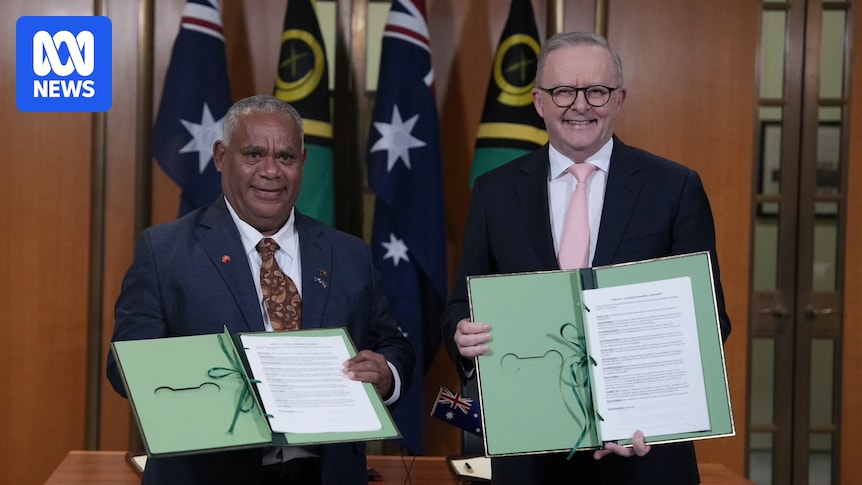
On Monday, Napat was due to meet Anthony Albanese in Parliament House to sign the Nakamal Agreement, a sweeping strategic pact with sharp financial and strategic consequences for his country, in front of a bank of cameras.
But there was something the delegation had to do before that.
After the Welcome to Country from indigenous leaders, Chief Peter Marcel, from the island of Tanna, stepped forward and conducted a klinim fes (cleaning face) ceremony.
There are slightly different interpretations about exactly why Vanuatu wanted to do this, and precisely what Napat and his team wanted to convey.
The klinim fes is a ceremony of reconciliation, and not one undertaken lightly.
Australian officials clearly saw it — at least in part — as a gesture of apology, after months of negotiations which veered between merely prolonged and the genuinely torrid, and which briefly exposed Albanese to ridicule after he travelled to Vanuatu for a signing ceremony that never actually happened.
One person on the Vanuatu side — who might have their own complaints about Australia’s conduct throughout the whole saga — suggested it was less about who was right (or wrong) and more about clearing the air.
But either way, the underlying message was crystal clear: it was time to wipe the slate clean.
And there were certainly plenty of resentments to clear away.
The Nakamal Agreement is a sweeping strategic pact with sharp financial and strategic consequences for Vanuatu. (ABC News: Lilyrose Welwel)
Nakamal agreement struck following many roadblocks
Those who have followed Australia on its long and difficult journey towards the Nakamal Agreement — its first ever comprehensive strategic pact with Vanuatu — have been around countless blind corners and run up against many dead ends.
It started with the ill-fated (and short-lived) 2022 security pact, which gave birth to Nakamal 1.0 negotiations which hit the roadblock of the aborted signing ceremony.
Then there was a public stoush over China’s police programs in Vanuatu, before hitting more controversy as Beijing’s own pact with Vanuatu heaved into view, running roughshod over a last-minute visa controversy before circling back, finally, to Monday’s signing ceremony.
After all that, the tension in Canberra in the lead-up to the signing ceremony (finally!) was palpable and information was very tightly held.
Memories of the prime minister’s embarrassment last year left plenty of scar tissue, and nobody wanted to do (or say) anything that might disrupt the carefully laid plans, or expose the government to ridicule should there be another last-minute disaster.
News of the visit started to percolate ever so slowly around Parliament House almost two weeks ago, but officials busy planning it quickly clamped down when asked about it.
One response, rather terse: “I absolutely cannot talk about that.”
Another: “Sorry mate.”
A third: “Zipped lip emoji.”
More theatrically, a fourth person said they’d been specifically threatened with “horrible consequences” if they spoke to any journalists or other denizens outside the knot of need-to-knows.
The “permanent contest” in the Pacific is not losing any intensity. (ABC News: Lillyrose WelWel)
But the most common response was total silence.
Foreign diplomats used to getting at least snippets of information from helpful Australian colleagues complained they were totally frozen out.
A media briefing planned for the Friday before the prime minister’s arrival was rather hurriedly cancelled (or, more charitably, pushed back).
Even the prime minister’s stripped-back announcement of Napat’s visit, issued on Saturday, did not contain a single mention of the Nakamal, only bland assurances about how both leaders would take the opportunity to progress the relationship.
‘Permanent contest’ for Pacific with China continues
The mood in Canberra has shifted markedly now the agreement is signed, and the deal is done, with a palpable sense of triumph and relief among those who led the charge.
So what does it all mean?
It will take years to judge the full impact of the Nakamal Agreement on the ground in Vanuatu.
But there are three quick observations worth making in the slipstream of the whole controversy.
First, the “permanent contest” in the Pacific is not losing any intensity.
There’s no (public) evidence that China expended any serious energy or political capital trying to block Australia’s landmark strategic pacts with small island states like Nauru or Tuvalu.
In Vanuatu, the contest was more live, and the stakes were higher.
Australia remains utterly convinced that China poured real time and effort into unpicking the Nakamal Agreement, despite the furious denials of the Chinese Embassy and Vanuatu’s government.
It was not just playing spoiler: China also kicked off secretive negotiations on its own pact with Vanuatu, the Namele Agreement, moving to entrench its own position at the same time.
China, in other words, is learning.
It’s showing more dexterity than its earlier forays into Pacific security, including its rather clumsy attempt to sign a Pacific-wide security treaty across the region.
Of course, Australia is learning too.
When Nakamal Agreement 1.0 bit the dust, there were many Pacific observers (including this one) who suspected it might lie dead, buried and cremated.
Diplomats from other countries started to speculate that both countries would end up signing a Clayton’s Nakamal, a deal that would preserve the impression of a strategic bargain without giving Canberra any real purchase in Vanuatu’s decisions on policing and critical infrastructure.
But the final version gives Australia more grip than sceptics expected.
The language on blocking investments might be dumped, but the government clearly believes that the commitments it has won — including the promise of no militarisation and the obligation to consult — will make it very difficult for China to establish a security foothold in Vanuatu.
As the Pacific Minister Pat Conroy put it, the government “tackled this challenge through a different way, through positive obligations rather than prohibitions”.
“We’re saying, yep, as long as it’s not militarised or has foreign interference, go ahead and have that infrastructure investment, and we’ll provide the technical assistance to make sure that you’re free from foreign interference,”
he said.
Australia is showing dexterity and adaptability here.
But there are also some sharp edges.
Questions over reputational cost
Because the second observation worth making is that we have clear evidence that Australia, when it meets resistance, is increasingly willing to play hardball to get its way in the Pacific.
The government has consistently denied persistent accusations that it has, at times, frozen or delayed development funding as a way of twisting ni-Vanuatu arms and forcing Jotham Napat to sign the pact.
But it had plenty of points of leverage and it’s obvious that it wasn’t afraid to use them.
Some of the pressure points clearly lay in grey areas, but others were more flagrant: for example, the decision to drop Vanuatu off the Pacific Engagement Visa ballot.
Expect its name to magically reappear sometime today, now that July 1 has ticked over, and the Nakamal has been done.
It’s not clear how much this move helped to get the deal over the line, but it has come at a clear reputational cost to Australia.
Vanuatu’s government may never have publicly criticised the decision, but it drew a furious response online, with locals on Facebook accusing Canberra of bullying and belittling behaviour.
Perhaps this will dissipate over time, but there’s a risk it will cement the worst stereotypes of Australia as a neocolonial regional hegemon throwing its weight around.
Loading
Wong signals ‘more to come’
The final observation is that Nakamal/Namele arm wrestle could well be a sign of what’s to come as Beijing continues to expand its presence and Australia races to bed down more strategic pacts with the dwindling band of Pacific nations that haven’t yet signed one.
When the Namele Agreement first started to circulate, it was clear that Australia had real anxieties that it could be a vehicle for China’s military ambitions in Vanuatu.
The very unusual media intervention by a (nameless) Australian official who warned Nakamal could be undermined if Vanuatu signed a “security” pact with China seems to indicate at least some dials were flashing Code Red in Canberra.
Officials and staffers in Canberra tended to get a grim set to their mouth when asked about it.
But the tone has shifted markedly in the last few weeks — perhaps indicating that Australia is more relaxed about the agreement.
Conroy told RN Breakfast yesterday that the Nakamal Agreement would provide all the protections Australia needed from any attempted incursions.
He also suggested that Australia was less worried about its contents than it was before.
“Prime Minister Napat has made it very clear that it’s a development agreement,” he said, adding that Australia had “a level of comfort” with the pact.
“Comfort” is not usually a word you associate with Australian officials when it comes to China in the Pacific.
One Vanuatu government source remains scathing about Australia’s response, suggesting that Canberra was jumping at shadows, and insisting that it should have been quicker to accept Vanuatu’s assurances that the agreement had nothing to do with security.
Foreign Minister Penny Wong has signalled there is more to come for Australia’s diplomacy in the region. (ABC News: Ian Cutmore)
But given Canberra remains convinced China wants a military foothold in the Pacific, the opacity of its diplomacy, and the stakes for Australia if we get it wrong — a level of calibrated anxiety is probably inevitable.
Still, knowing what is a code red — and what isn’t — is going to be absolutely critical if Australia is going to succeed.
There’s no doubt the Nakamal Agreement is a big moment for Australian diplomacy in the Pacific.
It’s also a harbinger of what’s to come rather than just the end of a long-running diplomatic saga.
As the Foreign Minister Penny Wong told journalists in parliament the morning after Nakamal was finally signed: “There will be more to come.”
That sounds like a promise.