




A three-year-old boy has been saved from underneath rubble caused by Venezuela’s two devastating earthquakes, six days after search and rescue efforts began.
Klieber Moran was pulled from the Los Corales Garden 1 building in the northern La Guaira state by Jordanian rescuers, Venezuela’s Acting President Delcy Rodríguez said in a message via Telegram.
Video footage from the scene showed rescuers cheering upon discovering the child. After being extracted, he received first aid and was immediately taken to hospital, the Jordanian civil defence said in a statement.
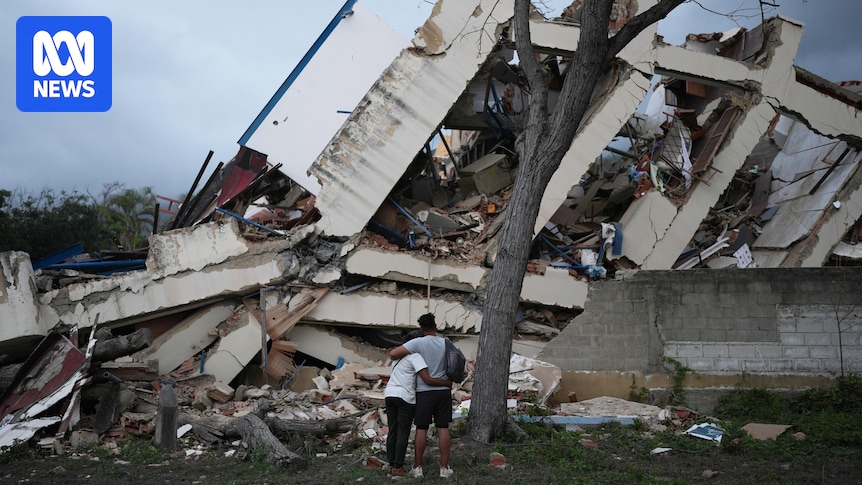
Preliminary estimates show almost 60,000 building across Venezuela are destroyed or partially damaged. (AP: Matias Delacroix)
In other footage, rescuers wiped the boy’s face with tissues and tucked him in with a blanket in an ambulance.
Experts say the 72-hour window after an earthquake serves as the crucial window during which people trapped under debris have a chance of being rescued alive.
The infant’s vital signs were good, the Jordanian statement said, adding that local authorities had been informed of the rescue.
Teams of rescuers from countries across the world have arrived in Venezuela to assist with search and recovery efforts. (AP: Ariana Cubillos)
Venezuela was hit by two earthquakes of magnitudes-7.2 and -7.5 less than a minute apart on June 24, toppling buildings and trapping thousands of people beneath the rubble.
National Assembly President Jorge Rodriguez said that 6,461 people had been rescued since the quake struck.
“We must hold onto the hope of continuing to find people alive beneath the rubble,” Mr Rodriguez said in a televised address.
Rescuers have managed to save almost 7,000 people in the six days since the two earthquakes struck. (AP: Matias Delacroix)
A shipment from UNICEF carrying 47 metric tons of humanitarian supplies arrived in Venezuela on Tuesday, local time, UN spokesperson Stephane Dujarric said.
The shipment included emergency health kits for urgent medical care, supplies for safe births, newborn care, disease prevention, and treatment.
Disaster turns into dire health and humanitarian issue
Tens of thousands of Venezuelans desperately continued to seek food and shelter on Tuesday, local time, after the earthquakes killed nearly 2,000 people.
The two tremors marked one of the worst earthquake disasters in Latin American history and prompted frantic search-and-rescue operations for survivors trapped in the ruins.
Thousands of Venezuelans have joined queues in search of emergency shelter, food and humanitarian aid. (AP: Matias Delacroix)
Six days after the shocks, the UN refugee agency said “food shortages are widespread, basic services have broken down and connectivity has been largely severed” in La Guaira.
“They give out supplies here, but sometimes people nearly kill each other for food … it’s like a cockfight,” Daniela Armas, an 18-year-old vendor in La Guaira who was injured falling from a motorbike during the quakes, said.
Mr Rodriguez said deaths had risen to 1,943, with more than 10,500 injured.
Many Venezuelans have not hidden their anger at the government’s slow response to the disaster in a country already struggling with decades of economic crisis that has weakened infrastructure and health services.
Multiple non-governmental organisations have set up emergency response tents in public areas of parts of Venezuela. (AP: Ariana Cubillos)
The UN agency said it needed some $US14.85 million ($21.46m) to scale up aid and temporary shelter for 30,000 people over six months.
The quakes likely damaged or destroyed 58,870 buildings, according to a preliminary assessment of satellite data published by NASA.
With thousands in need of help, World Health Organization spokesman Christian Lindmeier said health services in Venezuela were overstretched and under “extreme pressure.”
The names of dozens of people who remain missing in the wake of the disaster have been written on lists placed on buildings and vehicles in impacted zones. (AP: Matias Delacroix)
Without access to toilets, showers or soap, displaced Venezuelans have also become increasingly vulnerable to the outbreak of preventable diseases like measles, given the population’s low vaccination rates, Mr Lindmeier said.
He also added that conditions were ripe for waterborne infections such as dengue, yellow fever and malaria to spread.
According to the government, the earthquakes damaged or otherwise compromised 38 hospitals nationwide.
The WHO said it so far had evaluated 21 of those facilities, three of which were no longer operating. Another six sustained damage and the rest were buckling under the influx of injuries.
Some residents haev resorted to sifting through rubble to find survivors themselves. (AP: Ariana Cubillos)
Many specialist doctors are still missing in the ruins, including officials in charge of maternity care in La Guaira, WHO said.
“Findings reveal chaotic service delivery and patient flow, marked by overcrowding, growing surgical backlogs … and a breakdown in biosafety measures,” Mr Lindmeier said.
An increased presence of non-governmental organisations was noticeable on Tuesday, local time, in La Guaira and adjacent communities, with tents from the Red Cross, the World Food Program and other organisations set up on sidewalks, waterfront esplanades and athletic facilities.
People lined up throughout the day under the blistering sun to receive free toiletries, food, medications and face masks.
A man using his own machinery to dig through rubble and collapsed concrete in La Guaira. (AP: Ariana Cubillos)
Rescue efforts become grim scramble to find the dead
As international rescue teams from the US, Mexico and dozens of other countries scrambled with trained dogs and heavy equipment to dig out survivors, Venezuelans began burying the dead they could find.
Others were frantically searching by hand for missing loved ones in the rubble, but also in hospitals and morgues.
“It’s harder not knowing because you ask yourself, ‘What do I do? Where do I look for her?'” Rosanna Luna, who was looking for her sister Soraida in the wreckage of her home, said.
The death toll from Venezuela’s two devastating earthquake has risen to most than 1,900. (AP: Matias Delacroix)
Black body bags containing quake victims were lined up near a makeshift morgue at the dock in La Guaira on Monday, local time, the AFP news agency reported.
Darvin Silva, 37, described how he battled to reach his mother, who died under a pillar in a collapsed building.
“The effort it took me to get her out of there with my bare hands, with sledgehammers, with pickaxes … you can’t even begin to imagine,”
he said.
“I hope that I can now offer her the rest she deserves.”
About 50,000 people are still listed as missing, according to the UN.
Wires