





It was a crash that shocked thousands and suspended the day’s entertainment at Avalon Airshow early.
In March last year, pilot Glenn Collins was performing in a four-plane stunt demonstration when his aircraft crashed into the ground a few hundred metres from spectators.
They reported hearing a loud gasp as his aircraft hit the ground.
The experienced pilot was part of Paul Bennet Airshows’ Sky Aces team and was attempting a triple avalanche manoeuvre that involves a loop with three “snap rolls” at the top.
A snap roll is a quick full rotation of an aircraft around its longitudinal axis while flying.
Despite wearing a five-point restraint, the pilot sustained serious head, chest, abdominal, spinal and leg injuries.
He required five weeks in a Melbourne hospital before being transferred to Sydney to be closer to family in the Hunter region of New South Wales.
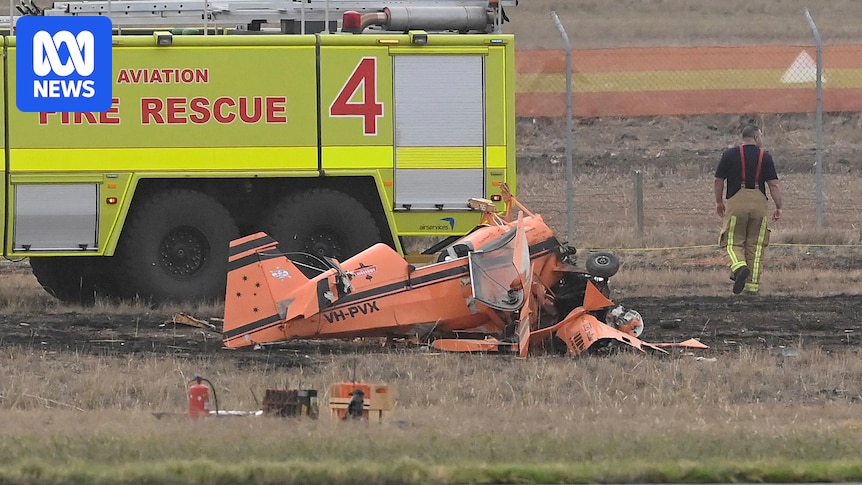
Wreckage of Glenn Collins’ plane after a crash during the Avalon Airshow in March 2025. (Supplied: Australian Transport Safety Bureau)
Last year, a post on a crowdfunding platform, said Mr Collins had suffered “life-changing” spinal injuries and was yet to recover full feelings in his legs and waist.
Investigators still don’t know why he attempted the trick at half the height he usually would.
“We don’t have the answers as to why, only that really that occurred. And I’m sure Glenn Collins would be asking himself the same questions as well,” Angus Mitchell, Chief Commissioner of the Australian Transport Safety Bureau said.
The bureau’s report found Mr Collins, aged in his 50s, had previously successfully completed the manoeuvre beginning at 200 feet in the same plane.
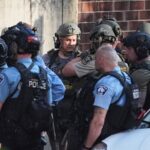
Emergency services at the Avalon Airshow after a plane crashed on March 28, 2025. (ABC News: Kate Webber)
The ATSB noted Mr Collins had more than 2,000 flying hours and all relevant qualifications and practices needed for the manoeuvre ahead of the performance.
ATSB investigators recovered a forward facing GoPro from within the cockpit that provided significant information.
The altimeter and airspeed gauges could be seen in the footage when Mr Collins’ head wasn’t blocking them.
“Video evidence showed on at least two previous occasions the pilot began the manoeuvre at 200 feet above ground level, started the snap rolls at approximately 800 feet, gained height during the snap rolls and recovered the aircraft,” it reads.
On the evening of the crash, Mr Collins began the manoeuvre at 100 feet above ground level.
Loading…
The ATSB also found several factors increased the time it took for emergency services to reach Mr Collins.
The crash scene was inside the show’s pyrotechnics area so firefighters had to assess the risk posed to them before approaching the crash.
One rescue vehicle had to use an alternative route because of a “departing aircraft” and it took approximately 14 minutes for paramedics who were onsite to reach the crash because they needed escorts.
Glenn Collins was seriously injured in the crash. (Facebook: Paul Bennet Airshows)
It also found the Pitts S1-11X aircraft did not have instructions on how open the canopy from the outside.
“First responders managed to pull the canopy open in approximately 50 seconds after they arrived onsite. Instructions for opening the canopy may have reduced this time,” the report reads.
The ATSB posits these factors could have reduced the time taken to provide help to Mr Collins but pyrotechnicians extracted him from the cockpit in case of fire and firefighters attended to the pilot within four minutes of the accident.
“Therefore, it was unlikely that the severity of the pilot’s injuries were increased due to the location of the accident,” the report reads.
New rules for stunt pilots
Organiser of the Avalon Airshow, the AMDA foundation, says it accepts the findings of the ATSB report and has vowed to make future air shows the safest in the world.
For general aviation in Australia there is a minimum height level of 1,000 feet over populated areas and 500 feet elsewhere, but these rules don’t apply at air shows.
A GoPro from within the cockpit provided significant information on the crash. (AAP Image: Michael Currie)
CEO of AMDA Justin Giddings said at future air shows stunt pilots will be required to fly at least 100 feet off the ground.
“Before they had permission to go down to the ground and that really gave them no margin for error. This means even if they do start off with their manoeuvre too low, it gives them a 100 feet buffer so hopefully we don’t have a repeat of what happened at the last air show,” he said.
He said the new requirement would have prevented the crash that seriously injured Mr Collins.
The AMDA foundation said from now on all emergency and first responders would be given an induction including specialist training on how to open aircraft canopies, more access routes would be made for vehicles through pyrotechnic areas, and there would be different locations for ambulances at the event.