







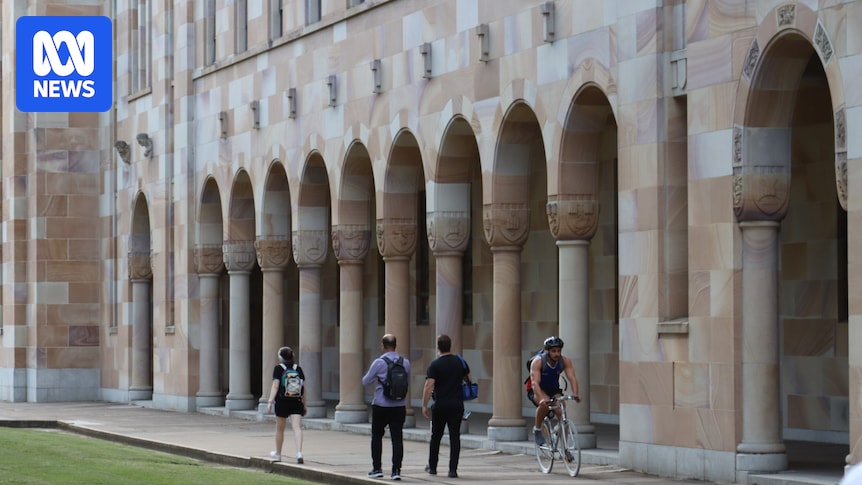
Australian universities have been warned they risk losing accreditation for government funding if they fail to commit to addressing antisemitism, under new laws that come into force next month.
“From 15 July, the university threshold standards will require universities to demonstrate the action they are taking to prevent and respond to antisemitism and other forms of racism,” federal Education Minister Jason Clare said today.
The changes were considered a top priority by the Antisemitism Education Taskforce, which said it “provided detailed feedback” on the proposed legislative amendments, as part of an interim report released this morning.
Jason Clare says the changes will take effect from July 15. (ABC News: Lucas Hill)
The taskforce was set up after last year’s Bondi terror attack to prevent, address and respond to antisemitism within the education system.
It has also launched a “social cohesion hub” for schools and teachers to combat antisemitism, with lessons on the Holocaust, avoiding hate speech and unconscious bias.
Roughly half of the 50 resources will focus on antisemitism.
“There is no place for the poison of antisemitism anywhere in our society,”
Mr Clare said.
“There is a lot that we as a country need to do to tackle antisemitism and improve social cohesion and what we do in education is an important part of that.”
The government said the social cohesion hub would cost $6 million over five years to maintain.
“By putting these free online resources in one place, the [hub] will support schools and educators to help students at all stages of their education journey to combat antisemitism and other forms of discrimination,” taskforce chair David Gonski said.
David Gonski is the chair of the Antisemitism Education Taskforce. (Getty: Bloomberg)
States are also piloting training designed by UNESCO, the specialised United Nations agency dedicated to promoting world peace, for Australian schools, teaching teachers and policymakers about best practice for addressing antisemitism and discrimination.
“My strong hope is that the hub together with the UNESCO teacher training program being piloted in Australia will help support schools to respond to the rising levels of antisemitism, as well as intolerance and prejudice more broadly,” Jillian Segal, Australia’s Special Envoy to Combat Antisemitism, said.
The Greens said the social cohesion hub would create a “hierarchy of racism where some victims are seen as worth and others are seen as an afterthought”.
“[It] includes 24 resources on antisemitism, but just two on Islamophobia and one on First Nations hate,” education spokesperson Mehreen Faruqi said.
“When some Australians are wrapped in the protection of the government, while others are left to weather the storm alone … it is not going to lead to anti-racism or social cohesion.”
The Australian Curriculum Assessment and Reporting Authority (ACARA) has also been tasked with a wider review of the national curriculum due to be completed by the end of the year.
The taskforce said this review would “help identify, reject and prevent antisemitism and strengthen an understanding of Australian values”.
“What we teach in schools is important here too. That’s why education ministers have agreed to a focused review of the school curriculum,” Mr Clare said.
“It will look at opportunities to combat antisemitism and strengthen understanding of Australian values.”
Universities will still receive report cards
The review says the government will amend legislation to strengthen the Tertiary Education Quality and Standards Agency (TEQSA), making a commitment to addressing racism a condition of accreditation.
TEQSA would also have powers to monitor a university’s compliance to their commitments.
The education minister has the power to amend the legislation after consultation, without needing the changes to pass through parliament.
The mid-year review has also revealed universities had been asked by Ms Segal to provide a timetable for adopting a definition of antisemitism by the end of August.
Ms Segal tasked former vice-chancellor Greg Craven with delivering university report cards, grading each institution on its progress tackling antisemitism.
However, last month Professor Craven delayed the report cards after he found not a single university had adopted an enforceable definition of antisemitism.
The report cards will now be due in 2027.
The taskforce said it was considering further ideas from across the education sector on teacher professional development, student safety and changes to regulation and funding.
Academics and their union have voiced concerns that some definitions could threaten academic freedom by preventing criticism and scholarship on Israel.
The taskforce also revealed that a Commonwealth Research Grants Working Group would deliver advice by October on aligning grant decisions with a policy of combating antisemitism, hate and extremism.
The final report from the Antisemitism Education Taskforce is due to be handed to the government in December.