







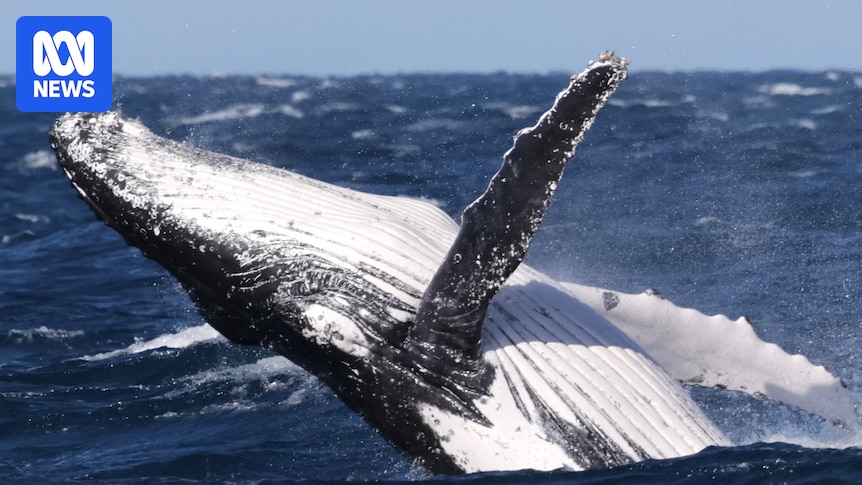
Whale numbers spotted along Western Australia’s coastal migration path have reportedly fallen by 60 per cent, leaving marine scientists and tourism operators speculating on an unconfirmed threat to the humpback population.
WA’s coastline is a critical migration route for several whale species, with humpbacks making their northward migration to their breeding grounds between June and November.
In a recent national whale census, scientists and volunteers at Cape Naturaliste, 260 kilometres south of Perth, spotted just 22 humpback whales, compared to 69 and 62 in 2025 and 2024, respectively.
Geographe Marine Research group chair Capri Jolliffe said the figures were highly unusual, and far beyond the 20 per cent variability that scientists would expect.
ORRCA Australia’s annual whale census took place on June 28. (Supplied: Geogrpahe Marine Research)
“I would not expect [food availability] to account for this much discrepancy in numbers … there’s definitely something else at play,” she said.
The Department of Biodiversity Conservation and Attractions (DBCA) told the ABC it was not aware of any significant decrease in humpback whale activity in WA’s South West.
“The timing of the annual whale migration can change by several weeks each year, and in some years we see more whales than others, likely driven by reproductive cycle or food availability,” a spokesperson said in a statement.
Decline ‘never seen’ before
Whale-watching charter operator Paul Cross said this year’s whale numbers were the worst he’s seen in 17 years of operation.
His staff provided their own snapshot of migrating whale numbers over the weekend, counting 32 whales from two tours, down from 93 last year.
“I’ve never seen the numbers in Flinders Bay as low as what I have this season,” he said.
“The numbers of these whales were down around about 60-65 per cent — for us, that’s starting to get really concerning.“
Paul Cross says this season’s whale numbers have been unusually low. (ABC South West: Jon Daly)
Mr Cross said he doubted the usual reasons for reduced numbers were the sole cause for the drop-off.
“We could say ‘listen, it’s a very late season or they’re just a little bit out further than what we would normally see them’,” he said.
“The whales we’ve seen aren’t happy, and something is causing that, and we want to find out what it is.
Multiple whale-watching operators have reported disconcertingly low whale numbers this season. (ABC South West: Jon Daly)
Scientists want investigation
While the exact cause is still unknown, Dr Jolliffe and her research group are theorising transmission of H5 bird flu could be behind the declining whale numbers.
The research group said limited Antarctic food availability and late migration could also be contributing factors.
Four confirmed cases of the infectious H5 bird flu have been found in migratory seabirds on WA’s south coast, and one further case in South Australia.
Australian authorities say there is no evidence of mass deaths or spillover into other non-migratory bird species or mammals on Australia’s mainland.
The same strain has been responsible for mass mortality of southern elephant seal pups on Heard Island, 4,000 kilometres south-west of mainland Australia.
Whale researchers, Dr Capri Jolliffe (right) and Professor Karen Edyvane, discussing whale migration. (ABC News: Anthony Pancia )
Dr Jolliffe said unverified theories of transmission of H5 in the humpback population needed to be investigated by authorities.
She said whales had been observed exhibiting ‘worrying behaviour’ along WA’s coastline.
“There’s a southern right [whale] in the cut at Dawesville at the moment, which is really, really unusual,” she said.
“It appears to be quite disoriented and swimming in circles.
“There’s a whole heap more work that needs to be done to actually see if that’s what’s causing this.“
Dr Jolliffe said whales were in close quarters with potentially infected seabirds in their natural habitat near Antarctica.
Dr Vanessa Pirotta says bird flu is a legitimate concern for whale populations. (ABC News)
Australian marine scientist Vanessa Pirotta said H5 bird flu could not be ruled out.
“We know that these animals face a number of different pressures, both human and natural-induced,” she said.
“Bird flu was one of those things we need to consider because bird flu is, unfortunately, global.
“These whales are migrating down to areas like Antarctica, where we know bird flu was there prior to even arriving here in Australia.”
Marine scientists theorise the decline could be attributed to a number of causes, including food availability and H5 bird flu. (Supplied: Naturaliste Charters Whale Watching)