






Nerilie Abram has gone where most people will never go, and has done it five times.
Nerilie Abram has been the Australian Antarctic Division’s chief scientist since August 2025. (Supplied: Australian Antarctic Division)
For the chief scientist of the Australian Antarctic Program, the harsh and icy continent is an endless source of fascination and wonder.
“Antarctica really gets into your blood,”
Professor Abram said.
The climate scientist has been part of crucial Antarctic research expeditions, including to the rapidly melting Denman Glacier.
But it is the realities of day-to-day survival in one of the world’s most extreme environments she thinks will surprise people most.
Nerilie Abram on James Ross Island in 2008, collecting ice cores as part of her work for the British Antarctic Survey. (Supplied: Australian Antarctic Division)
“I’ll get to Antarctica and then fly out onto the ice sheet, and we’re just there with a really small team, living in tents on the ice for months at a time,” Professor Abram said.
“You have to pay really close attention to the weather forecasts … do we need to make sure everything is tied down because there might be a blizzard coming through?
“Even when it comes to dinner time, going and digging in the snow and pulling out a vacuum pack of food and going, ‘Oh, what are we going to eat tonight?'”
‘One of the greatest Antarctic collections in the world’
This 1975 Mole Mink was manufactured in Sydney using Holden engines but constructed by technicians in Antarctica. (ABC News: Lily Nothling)
Australia has an enduring connection to Antarctica, but visiting the frozen continent is out of reach for most.
A major new Antarctica exhibition at the National Museum of Australia is giving visitors a chance to explore life on the ice, and the stories behind more than a century of exploration.
The exhibition features more than 200 objects and artefacts, donated by the Australian Antarctic Division.
Laura Cook says Antarctica holds a fascination for Australians as a “living archive of our past”. (ABC News: Lily Nothling)
“It was a huge and vast series of treasures,” senior curator Laura Cook said.
“And really, [it’s] probably one of the greatest Antarctic-related collections in the world.“
Many of the objects have never been on display before.
A model of Mawson station on display at the National Museum of Australia. (ABC News: Lily Nothling)
They include a range of oversnow vehicles, including the unique 1975 Mole Mink, which was manufactured in Sydney using Holden engines but constructed by technicians in Antarctica.
There is a 1955 barge caravan used as temporary accommodation during the construction of Mawson station, and a mammoth 8.5 tonne tractor described as the “workhorse” of the Australian Antarctic Program, and one of the heaviest objects the museum has housed.
A sled and skis used by Australian explorer Cecil Madigan in 1912 are also on show.
A barge caravan used as temporary accommodation in 1955 during the construction of Mawson station in Antarctica. (ABC News: Lily Nothling)
So too is a baggy yellow jacket worn by Diana Patterson, the first woman to lead an Australian Antarctic station.
“Diana had to take a smaller size because at the time she joined the division, there wasn’t specific clothing made for women,”
Dr Cook said.
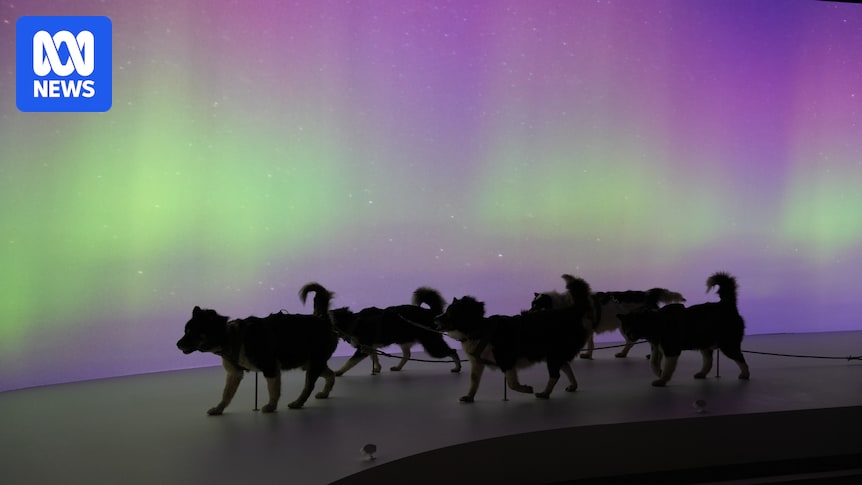
There are 12 taxidermied sled dogs, bred between the 50s and 90s, who formed deep bonds with isolated expeditioners.
Taxidermied sled dogs at the National Museum of Australia’s Antarctica exhibition. (ABC News: Lily Nothling)
Visitors can also see ration packs and a bottle of beer brewed in Antarctica in 1969, an activity that was a popular pastime for decades.
Some of the objects are more personal, including diaries and letters from explorers.
“When I think of all the fellows slaving in officers in cities when there is all this beautiful God’s world to explore and all its wonders to see, I pity them,” 21-year-old surveyor George Dover wrote in 1912.
Some of the items on display relate to the personal experiences of Antarctic explorers. (ABC News: Lily Nothling)
Inspiring the next generation
The exhibition has been in the works since 2022 and Dr Cook said it was one of the biggest and most rewarding of her career.
“I think Antarctica holds the most incredible fascination for Australians because it affects us all,” she said,
“Antarctica is not only a living archive of our past, but it is a warning system for our future.“
The Antarctica exhibition will run from July 1 to October 11 at the National Museum of Australia in Canberra. (ABC News: Lily Nothling)
Professor Abram said she was thrilled the exhibition was helping to tell the stories of Australians who had dedicated their lives to research and conservation.
“With any luck, it will also inspire the next generation of scientists, explorers and adventurers to add their own chapter to Australia’s Antarctic story,”
she said.
The exhibition opens to the public at the National Museum of Australia on Wednesday, July 1.