






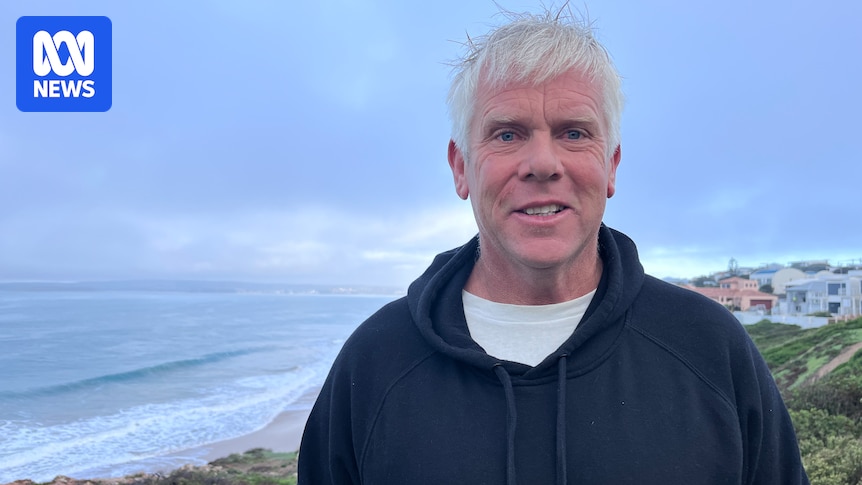
A surfer who spotted the first bird in South Australia to test positive for H5N1 avian influenza says the giant petrel looked fatigued and distressed before it was retrieved by wildlife rescuers.
Ben Wood told 891 ABC Adelaide a southern giant petrel landed where the waves were breaking during a bodyboarding competition at Knights Beach, in the Fleurieu Peninsula, on June 14.
“[It] got hit by a couple of waves and was washed up to the beach,” Mr Wood said.
Mr Wood said the migratory bird was retrieved by a local wildlife rescue group, which said it was working with authorities after the animal had tested positive on June 24.
SA recorded avian influenza in a giant petrel found at Knights Beach on June 14. (Wildlife Welfare Organisation)
Bodyboarder Aaron Brand told radio station FiveAA he touched the sick bird as he tried to encourage it to fly out of the surf break zone.
“Mid-heat the bird just flew in between us and just sat there with us and next minute started getting a bit pushed into where the waves were breaking and I paddled over to see if it would fly away and kind of touched it,” Mr Brand said.
“Tried to have a bite of me and I was like, ‘Oh I’m not going to touch that now.’
“It just got pummelled by waves and pushed into shore.
“Another surfer picked it up and put it on the beach and the wildlife people came and collected it and we thought nothing of it.”
Mr Wood said two weeks earlier he physically retrieved another fatigued petrel which also landed at Knights Beach while he was surfing.
“I did make direct contact with the initial one, but I did not touch the one on the competition day,” Mr Wood said.
“They were both very fatigued, disoriented — to land in this particular surf break is quite a nasty, very violent sort of wave, for them to land after flying such distances, to be so close to the mainland and not land on shore.”
Since three H5 cases were confirmed in Australia, several veterinary clinics in South Australia have posted to social media that they would not accept sick wild birds while others advised people to call ahead.
The risk to humans
SA Chief Public Health Officer Professor Nicola Spurrier said it was possible for humans to catch bird flu but the risk to the human population is low.
Professor Nicola Spurrier said the risk of bird flu transmitting between humans is “very rare”. (ABC News)
“But you have to have really close contact with an infected bird and by that I mean you have to be touching the bird and having some of the secretions from the bird enter our mucus membranes,” Professor Spurrier said.
“So walking past a dead bird, you are not going to catch bird flu or even if the bird is a bit sick and just walking past you are not going to catch it.”
Professor Spurrier said avian influenza symptoms are similar to regular flu symptoms such as a sore throat, runny nose, high fever and aching muscles.
The Chief Public Health Officer said it was very rare for human-to-human transmission of the disease.
“That’s why we’re not concerned about this as the next pandemic or anything like this” Professor Spurrier said.
“The population level risk is very low, it’s just in terms of transmission if you happen to be in close contact with a sick or dead bird.”
Professor Spurrier urged the surfers or anyone that was worried they might have touched a sick bird to seek health advice from their GP.