








With multiple migratory seabirds in Australia confirmed to have a deadly strain of bird flu, governments, agricultural specialists and conservationists are springing into action to protect Australia’s animals.
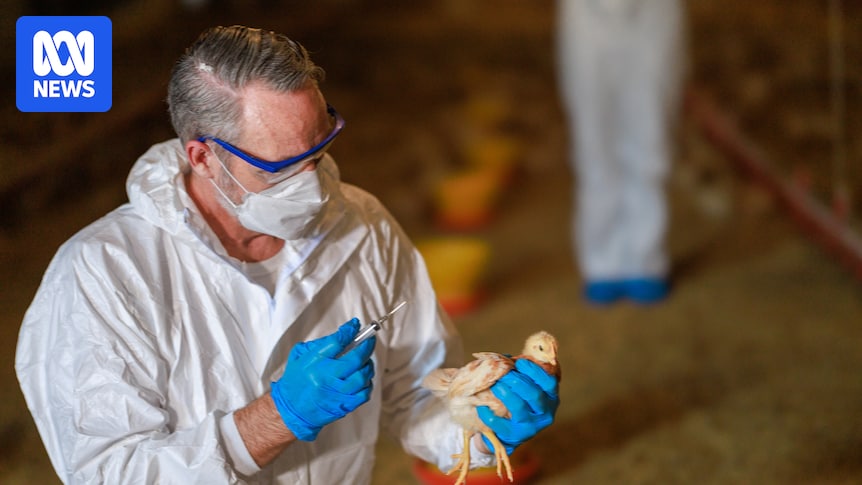
Avian influenza vaccines have been used in several countries in Asia to manage bird flu for years, but routine vaccination for poultry flocks is banned in Australia.
Deakin University ecologist Marcel Klaassen said vaccines could limit serious disease, but needed to be used carefully.
“They have been used for decades,” he said.
“But they are not ideal.”
Stumbling blocks to widespread uptake by some countries around the world, including the US and Australia, in the past have been the potential for vaccinated flocks to “silently” carry the virus, as well as impacts on trade.
But as the deadly H5N1 2.3.4.4b strain of the virus swept around the world — devastating both farmed and wild animal populations, and infecting hundreds of people coming into contact with infected animals – the question of whether or not to vaccinate poultry has become more urgent.
The H5N1 strain of bird flu has spread around the world. (ABC News: Nicole Hegarty)
The US recently approved vaccines for conditional use, but primarily continues to use culling to contain bird flu.
The ABC asked the Department of Agriculture Fisheries and Forestry about whether Australia planned to introduce vaccines, but they did not reply before deadline.
However, when asked about vaccines by Patricia Karvelas on ABC Afternoon Briefing, Agriculture Minister Julie Collins said that vaccinations would be “primarily be in wildlife”.
“We have been doing exercises, working with states and territories, working with wildlife and environmental groups [and] working with industry groups about how do we can best contain it should it arrive in Australia,” Ms Collins said.
What bird flu vaccines are available?
Avian influenza — bird flu — is caused by a number of viruses, most of which only cause low levels of sporadic disease outbreaks.
However, two of the strains, H5 and H7, cause severe disease and are highly infectious.
When infected with H5 and H7 strains, birds struggle to fly, have breathing problems, neurological issues and can die suddenly.
According to University of Queensland virologist Kirsty Short, avian influenza is very similar to human influenza.
“They’re the same virus — they’re both influenza A, they’re just different subtypes,” she said.
There are a number of different avian influenza vaccines that have been developed around the world for use in the poultry industry, but not all of them are available for widespread commercial use.
Dr Short said that while there were multiple vaccines, there was not a “universal” vaccine that worked against all influenza strains.
Instead, they need to be updated as the strains mutate.
Researchers have long been trying to find a universal flu vaccine for humans, Dr Short said, but it was unlikely there would be one for human or avian influenza for a while.
“I don’t think it’s impossible, but I don’t think it’s going to happen in the next couple of years,” she said.
There are no commercially available bird flu vaccines for mammals such as dairy cows or minks.
How do the vaccines work?
Vaccines against avian influenza work in the same way as human vaccines such as those used for influenza or COVID-19.
But just as COVID-19 vaccines were protective against severe disease, they do not entirely stop the spread.
That means that some animals might not show symptoms but still shed the virus and spread it.
Professor Klaassen said this could become an issue if surveillance was not done, or the vaccine was not kept up to date.
“A perfect vaccine — that is a vaccine that stops the disease in its tracks — doesn’t allow it to replicate in its host,” he said.
“We don’t have a perfect vaccine yet.“
This means that if industries are using the vaccine, they also need to ensure that the virus is not spreading under the radar.
Multiple studies undertaken by Professor Klassen’s team have looked at the rate of infection in Bangladesh’s poultry industry.
“Bangladesh introduced the vaccine in 2012 and they haven’t changed them since,” he said.
Both commercial poultry and backyard chickens can be infected with the virus. (ABC News: Jonny McNee)
He found that about 50 per cent of the animals tested in wildlife markets and farms were infected with avian influenza during the reporting period, despite them being vaccinated.
“We call this silent spread,” Professor Klaassen said.
“You don’t notice it because they are protected from severe disease.”
This means that the virus can spread further, potentially infecting other farms, other agricultural animals, or wild animals.
“You can’t rely on whether [the animals] drop dead or not, because it might be protected for disease, but [the virus] might still be circulating,” Professor Klaassen said.
He said implementing a vaccine program could also be difficult.
“It’s the rolling out of a vaccine program where things can go horribly wrong,” Professor Klaassen said.
What’s the best way to roll out vaccines?
Because influenza regularly mutates, it is difficult to keep vaccines up to date.
Professor Klassen said China updated its avian vaccination program every two years to keep protected from newer strains.
But he said that was still not frequent enough and, without continued surveillance, the virus could still travel undetected.
Professor Klaaseen said using vaccination alongside culling was the best practice until a perfect or near-perfect vaccine could be developed.
“In Europe they now allow for vaccination against [avian] influenza in very specific cases,” he said.
“You have to have a whole sampling program. And when you then discover that despite vaccination, it’s still circulating in your flock, you have to eradicate them.”
Sampling or testing flocks regularly ensures that the animals do not have this silent version of the virus.
This is what is being done in Europe, and while animals still need to be culled if they get infected, it can be useful to minimise outbreaks.
While vaccination against avian influenza is not permitted in Australia for domestic poultry, this may change if the outbreak spreads significantly into farmed poultry populations.
Will native species be vaccinated?
According to Tiggy Grillo, the National Coordinator of Wildlife Health Australia, some countries have already begun vaccinating native birds.
“The Californian condor is one species in the US where they’ve undertaken vaccination because they were such a threatened species,” she said.
California condor populations were heavily affected by avian influenza. (Flickr: California condor at Bitter Creek NWR/USFWS Pacific Southwest Region/Public Domain)
There are several research trials underway into the effectiveness of the vaccines on wild animals around the world.
“King penguins have been vaccinated on one of the French islands to the south of South Africa,” Dr Grillo said.
There are also very small scale trials to test vaccines for mammals such as monk seals.
The delay on H5N1 arriving in Australia has meant that conservation, agriculture and governments have had time to prepare.
Australia has also undertaken limited trials of the vaccine in captive species of birds, Dr Grillo said, but it was not the only strategy used to protect wildlife.
“It’s not a silver bullet,” she said.
“But it’s certainly … part of our toolbox and we can consider using it for specific species.”
Anyone who sees a dead or sick bird is asked not to touch it. They should report it to the Emergency Animal Disease Hotline on 1800 675 888.