







A decades-old pipeline supplying water to nearly 1 million people in Papua New Guinea’s capital is at risk of collapsing without urgent repairs, threatening to cut off more than half of the city’s water supply.
Residents are being urged to remain calm while emergency planning is underway to fix segments of the pipeline.
It is just one part of an Australian-built water infrastructure network that has been operating under “extreme” and “unsustainable” risk, while the nation’s state-owned water utility is effectively insolvent, the ABC can reveal.
Port Moresby’s population has grown rapidly in recent years, far outstripping the capacity of the city’s aging water infrastructure, which was built by Australia in the 1960s before Papua New Guinea gained independence.
Documents seen by the ABC say decades of underinvestment in the water supply system has left it in a “fragile state” with multiple leaks, including one jet of water that has become so “powerful” it has created a sinkhole.
Documents say one major leak has created a large “flooded zone” around a sinkhole. (ABC News)
A major failure in the system could create a public health and security emergency in Port Moresby and damage the country’s economy, the documents warn.
The PNG government is working with the United Nations and international partners, including Australia, to address the issues.
James Young, CEO of the public water utility, Water PNG, said the disruptions caused by emergency repairs to the failing pipeline were unfortunate, but necessary.
“A planned temporary partial shutdown of this pipeline will be required, in line with engineering assessments and community consultation,” he said.
“Measures will be in place to minimise interruption while the repairs are undertaken.
“The public and businesses will continue to be informed in the lead-up to and during the repairs.”
Early crisis warnings
Documents seen by the ABC claim Water PNG began warning the PNG government of a water infrastructure crisis more than a year ago.
“Port Moresby’s water supply system is now operating under extreme and unsustainable risk, with multiple critical assets … at or beyond end-of-life,” a Water PNG report from November 2025 said.
“These critical assets have suffered protracted degradation and are showing signs of imminent failure.”
An example of leaks along a flume that forms part of Port Moresby’s water supply network. (Supplied)
It warned the city’s water system had almost no redundancy or storage buffer and a major failure was likely to rapidly reduce water supply to the city, with cascading health, security and economic consequences.
Water PNG wrote that it had warned the PNG government of problems since April last year in a series of formal letters.
“These correspondences outlined how decades of underinvestment in maintenance and upgrades, coupled with governance weaknesses in the sector, have left the city’s water supply system in a fragile state,” the report said.
It also said Water PNG was effectively insolvent, with the PNG government owing more than $80 million in unpaid water bills to the cash-strapped utility.
PNG Prime Minister James Marape told the ABC he only became aware of the situation in recent months.
“I was informed of this early this year and then that’s the reason why we have a cabinet proposal that came to us three cabinets ago,” he said.
Paul Barker says the work the government is doing should have taken place decades ago. (ABC News: Marian Faa)
But others are asking why the situation has been allowed to deteriorate.
Paul Barker, who heads Papua New Guinea’s leading policy think-tank, the Institute of National Affairs, said infrastructure upgrades and maintenance should have taken place decades ago.
“Preparation is occurring now but it’s very much last minute and almost desperate preparation,” he said.
Leak turns into ‘powerful jet of water’
Port Moresby’s water infrastructure was laid from the 1940s until the 1960s, when Papua New Guinea was under Australian administration.
The gravity-fed system channels raw water from a large dam on the mountainous outskirts of the city to a treatment plant in Port Moresby.
There has been very little maintenance since the infrastructure was built more than 50 years ago.
Steel pipe walls, originally 15 millimetres thick, have worn down to just 2 millimetres in some places, with hundreds of millions of litres of water rushing through them each day.
The pipeline’s steel walls have become so thin that holes have formed in some parts. (Supplied)
Among the urgent issues flagged by Water PNG were leaks in the primary raw water pipeline, known as Rouna 1/3, which feeds directly into the Port Moresby treatment plant.
One of the leaks has become so severe it has created a 6-metre-deep sinkhole and a flooded area extending more than 500 metres, one document said.
The leak is worsening and will require emergency repairs to prevent a catastrophic rupture, according to an engineering report seen by the ABC.
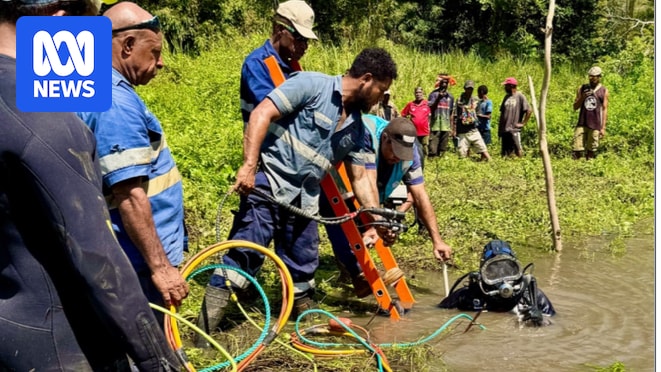
In May, a technical diver was sent into the large, swampy sinkhole with zero visibility to assess the leaking pipe, which is submerged under a growing body of water.
The documents say the sinkhole is several metres deep and surrounded by a flooded zone. (ABC News)
They found water was seeping from the pipeline at high pressure.
“This is a very powerful jet of water … if the water was flowing straight up it would reach a height of around 150 metres,” Mr Young said in a written statement.
An engineering report confirmed the pipe was in “active failure” and at high risk of a complete rupture if not repaired, with chances rising every month.
Report warns of worst-case scenario
Water PNG is preparing to fix segments of the pipeline — a highly complex operation that involves shipping in specialised equipment to PNG.
The works will also involve building roads and using heavy machinery to transport heavy steel pipelines into remote and mountainous terrain that is difficult to access.
Documents say the swamp surrounding the leakage point is several hundred metres long. (Supplied)
Documents addressed to the PNG government earlier this month, seen by the ABC, outline two key strategies for addressing the main leak.
One involves connecting the leaking pipeline to a different raw pipeline, allowing water to be diverted.
If successful, it would significantly increase the amount of water available to Port Moresby while leak repairs take place, reducing health, security and economic risks.
But that solution will take longer to implement — time the city may not have.
The more immediate option, which may be forced if the leak worsens considerably, involves shutting off the Rouna 1/3 pipeline completely to repair the leaking area.
Water supply to the city would be reduced to 40 per cent for a number of days and possibly weeks in a worst-case scenario.
“An uncontrolled rupture before September would remove the choice and force an emergency response with no redundancy in place,” the report states.
Water PNG has begun digging to prepare access to parts of the pipeline. (Supplied)
In response to questions, the country’s Minister for State Owned Enterprises William Duma referred the ABC to Water PNG, which has not provided a response.
The utility’s shareholder company Kumul Consolidated Holdings also did not respond to the ABC’s questions.
Sources speaking on background said work was being planned for late July.
In a statement, Mr Duma accused political opponents of politicising the water issue.
“There will not be a shutdown, but a reduction, in the water supply during repairs,” Mr Duma said.
“There is no date set for this to take place as it is dependent on engineering assessments.
“Critical repair components are currently inbound on ships from Australia and China, while other parts are being air-freighted from the Netherlands.”
Port Moresby residents already have ‘backup’
Despite the concerns, some are remaining positive about the situation.
Port Moresby Chamber of Commerce vice-president Chey Scovell said while water shortages could impact businesses, people and companies operating in PNG were used to overcoming adversity.
“If you were somewhere else and you had this, everything would grind to a halt. Whereas here, we’ll continue to operate,” he said.
Chey Scovell says most businesses and homes in Port Moresby have “some backup” in the event of water supply cuts. (ABC News: Marian Faa)
Mr Scovell said it was not the first time the city had experienced temporary water outages, although in the past they had only been for one or two days.
“The resilience that we’ve gained out of already living in that situation for a long time now means that most businesses and homes and restaurants and those commercial facilities have some backup,” he said.
“If you had to pick a country or a place that could survive or come out the other end of this … PNG would be at the top of my list.”