





Two dead seabirds have been collected and are being tested for the H5N1 bird flu virus in South Australia, following Australia’s first confirmed cases of the deadly variant this week.
Warning: This story contains images readers may find distressing.
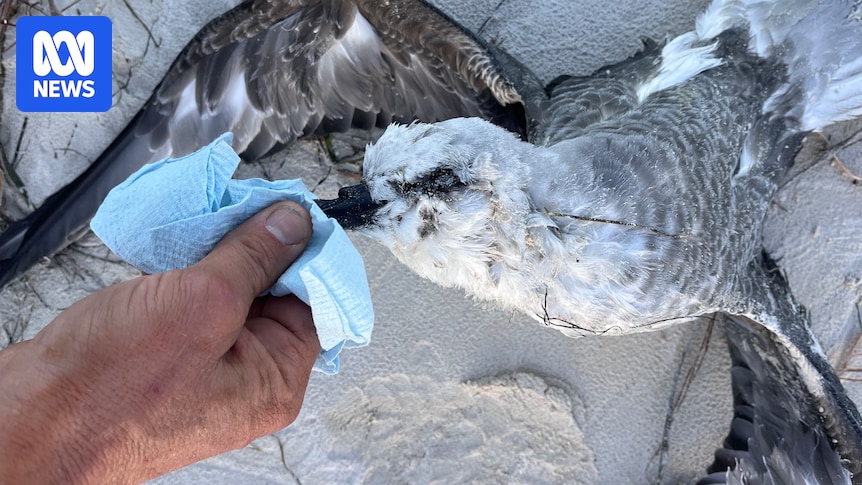
The birds, which are believed to be a white-headed petrel and another sub-species of petrel, were found washed up on the shores of Fowlers Bay Beach on South Australia’s west coast, 360 kilometres from the WA border.
BirdLife Australia says one of the birds found in SA is a sub-species of petrel, possibly a soft-plumaged petrel. (Supplied: Rod Keogh)
Both bird species, identified by BirdLife Australia, are subantarctic birds, meaning they breed or live in waters north of the Antarctic circle.
A pelican was also found dead metres away on the same beach.
The sightings came just days after confirmation of Australia’s first H5 bird flu detection in two subantarctic migratory birds on a beach in Esperance, Western Australia.
Esperance and Fowlers Bay are on the coastline that makes up the Great Australian Bight, but on different sides of the SA/WA border.
Fowlers Bay is a remote coastal fishing village on the western edge of South Australia’s Eyre Peninsula. (Supplied)
Stepping up monitoring
The South Australian government has increased its monitoring of the state’s west coast, particularly between Ceduna and WA.
South Australian Premier Peter Malinauskas today said the advent of the H5 strain of bird flu in Australia had triggered a suite of measures of joint state and Commonwealth monitoring.
“As a result of this detection [in Australia] there are a range of funding arrangements that kick in,” he said.
That includes a combined $8.1 million into the state’s Department of Primary Industries and Regions (PIRSA) for monitoring and response readiness.
Mr Malinauskas said the proximity of the confirmed cases in Esperance was of note to authorities.
“We don’t know if those birds [carrying the H5 variant] transmitted it to other birds that might migrate to South Australia,”
he said.
“These are live questions that we just don’t have the answer to.”
The premier said additional funding would be unlocked if the virus was detected in the state.
“This is different to [the] algal bloom. That hadn’t occurred in the history of the country,” he said.
“This is something we’ve known is a risk and we’ve been able to account and plan for.”
Sighting the dead birds
Fowlers Bay resident Rod Keogh spotted the two dead birds on Fowlers Bay Beach yesterday morning.
Mr Keogh reported the sighting to PIRSA, and within hours rangers had arrived and taken the bird samples for analysis.
Results will be determined in coming days.
Rod Keogh says it was confronting to find the dead birds on the beach. (ABC Eyre Peninsula: Jodie Hamilton)
BirdLife Australia senior adviser Sean Dooley said it was not unknown for seabirds to wash ashore after being killed in storms at this time of year.
Concern for sea lion population
Mr Keogh, who runs a marine tourism operation in the remote coastal town, feared the deadly bird flu would impact important sea lion populations on Nuyts Reef, near the town.
“Nuyts Reef is one of the largest Australian sea lion populations in the country,” he said.
Overseas outbreaks of the H5 bird flu variant have resulted in 30,000 sea lions being killed in South America.
Sea lions are also at risk from bird flu. (Supplied: Department of Environment and Water)
South Australia is home to 85 per cent of all global Australian sea lion populations.
“It is absolutely critical that we maintain vigilance if we’re seeing something on the beaches that is out of the ordinary, especially pelagic birds,” Mr Keogh said.
PIRSA and the CSIRO have been contacted for comment.
Loading…