


Cheryl van Wageningen is a proud descendant of the Peramangk and Ngarrindjeri peoples in South Australia.
But she only learnt of her heritage at the age of 35, when she received a letter in the mail informing her that she was Indigenous and had siblings who wanted to meet her.
It set Cheryl on a journey of connecting to her culture and unravelling family history she had longed to know about.
Warning: This story contains images of an Indigenous person who has died.
These are Cheryl’s words.
I was always asked why I have dark skin
I was born Charmaine Dawn Hunter and adopted as Cheryl Dawn Elburn.
I always knew I was adopted.
When I was about three months old, the authorities thought it best for me to go into an institution called the Kate Cocks [Memorial] Babies’ Home, at Brighton in South Australia.
That’s where a lady called Mrs Elburn was volunteering and she came home with me one day.
I first found out that I was Aboriginal when I was 35, nearly 36.
I came home from work one day and there was a letter there from an organisation called Link Up SA and it just really threw me.
Cheryl as a child, with her adoptive mother. (Supplied: Cheryl van Wageningen)
It said that I had siblings, and that they wanted to contact me, and it was someone with Aboriginality.
It was the mid-90s, I was married to my then-husband, I had my own children and out of the blue this letter turns up.
It took myself and my whole family by surprise.
I was always asked why I had dark skin. People thought I must be Greek or Polynesian, or Fijian or something like that.
My adoptive mother had actually met my birth mother when I was little, but she never spoke about her being Aboriginal.
If I asked questions, she would say “you’re our child now, you’re our daughter”.
She was very loving and it was a very loving family, but it was never, ever spoken about.
Finally, I’m going to get some answers
I kept the letter for a couple of days and then I thought, “well, I’m going to ring the agency and find out what this is all about”.
It was sort of comforting to think there was someone out there that, [who] maybe is related to me and could tell me some stories or fill in the gaps, so to speak.
But it was also quite confronting, like, who are these people? What are they expecting?
So I asked a few more questions to the people who sent out the letter, and they said, “it’s a younger sister; her name’s Mandy and she would like to meet with you”.
We both had the same mother, but a different father.
It was like looking into a mirror
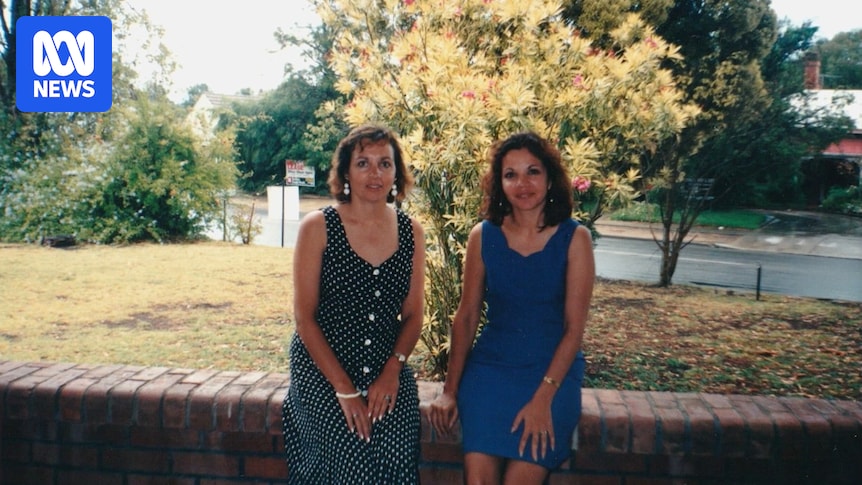
When I first laid eyes on Mandy, it was spooky.
We almost had the same outfit on.
We just hit it off and had so many things in common. We both played in a band, we both played piano.
Cheryl also met her brother, Michael. (Supplied: Cheryl van Wageningen)
There were only 10 months’ difference between us and then also I found out that I had a younger brother, Michael.
Michael was a good runner, and I was a runner also.
There were all these family things that we enjoyed that we could have grown up enjoying, which is really sad when you think about it. Better late than never.
We can now get together and just pick up where we left off.
Could she be my mum?
Mandy and Michael had also grown up in an adoptive family and had never met our mother or knew much about her.
The lady at the adoption agency had told me: “Your mother has moved on, she’s married, she’s had a family of boys, and I don’t think she’s told her husband [about you].”
I sort of accepted that, whereas my sister Mandy was quite determined to find out more and to meet her.
So her and Michael, unbeknown to me, went and found Mum and they ended up seeing her and getting a photo taken with her.
When they said the suburb that she lived in, I said, “oh my God, it’s only 2 kilometres away from me.”
I didn’t really pursue it because in my mind she didn’t want to see me.
But then you sit on a bus, or you go to the shops, and you sort of look at people and you think, could she be my mum?
I used to do that when I was a little girl, too.
As I grew older, I thought, “just bite the bullet and meet up with her”, but she had passed away, so that was really sad.
It’s taken me a long time to be able to talk about it and process things. I just try to think of the positives.
At least I’ve seen photos of her. I’ve met a lovely younger sister and younger brother and I’m learning more about my heritage.
Connecting to my culture through music
One of the things that was a revelation for me after finding out about my Peramangk and Ngarrindjeri heritage was learning that Ruby Hunter was one of our relations.
I thought, wow, she was a powerful singer-songwriter.
I never knew that I was related to someone like that.
Cheryl says she has used music to help connect with her culture. (Supplied: Cheryl van Wageningen)
It inspired me to embrace my culture and try to find a way of expressing what I’m finding out through composing songs.
My siblings and I are very passionate about reviving language, and I’ve actually been commissioned to do a piano composition that’s got some Peramangk and Ngarrindjeri language in it.
Being the firstborn daughter of the firstborn daughter also has these cultural obligations.
If we go somewhere I’ll do the Welcome or an Acknowledgement now.
It has been very interesting finding out my position in Aboriginal identity.
I have embraced it and so have my children.
Loading…